On a cold afternoon in Seoul, a man steps out of an office building, pulls his coat tighter, and walks straight into a clinic on the ground floor. He doesn’t hesitate. Inside, a small waiting room hums quietly—people sitting in neat rows, a digital screen ticking through numbers. Within ten minutes, he’s called in, explains that he’s been coughing since yesterday, and walks out shortly after with a prescription in hand.
The entire visit takes less time than his coffee break.
To someone unfamiliar with South Korea, this can feel unnecessary. A cough is usually something to wait out. But in Korea, going to the doctor for something minor isn’t seen as overreacting—it’s simply the easiest option available.

When Healthcare Is as Close as a Convenience Store
In many Korean neighborhoods, clinics are not destinations—they are fixtures.
They sit between cafés, pharmacies, and convenience stores, often occupying the first floor of residential buildings. You might pass three or four within a short walk without even noticing. This density reshapes how people think about medical care.
There’s no need to plan a visit days in advance. No need to arrange transportation or clear your schedule. If something feels slightly off, you can simply step in.
That physical closeness quietly lowers the threshold for action.
A Five-Dollar Decision
Cost is where the system becomes even more distinct.
A typical visit to a local clinic—what Koreans call a “primary care clinic”—often costs around 5,000 won out of pocket. Roughly the price of a simple meal or a few cups of coffee.
At that level, the decision changes shape.
It’s no longer a question of whether the symptom is serious enough to justify the expense. The financial risk is so low that it barely enters the calculation. A cough, a sore throat, mild fatigue—these are all reasons people feel comfortable checking in with a doctor.
In practical terms, it’s easier to go than to wonder.
The System Behind the Simplicity
This ease is not accidental. It is built on South Korea’s national health insurance system, which covers the majority of the population and keeps primary care costs low.
Clinics are structured to handle high volumes efficiently. Doctors move quickly but with familiarity—many patients return to the same neighborhood clinic repeatedly over the years. There is a sense of continuity, even within a fast-paced system.
The process itself is streamlined. Registration, consultation, prescription, pharmacy—often all within the same block.
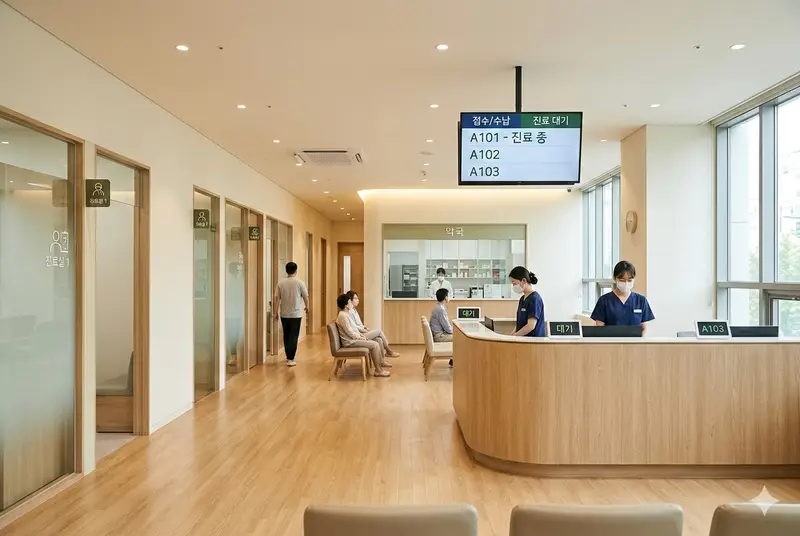
Built for Speed, Not Delay
The design of the system encourages early visits rather than delayed ones.
In many countries, people wait because the system requires it—appointments are scarce, costs are high, or access is limited. In Korea, the opposite is true. Availability is high, and the process is fast.
So behavior adapts accordingly.
Instead of monitoring symptoms over several days, many people choose to resolve them immediately. It’s not driven by urgency, but by convenience.
Annual Health Checkups: Prevention as Routine
There is another layer that shapes this mindset: regular health screenings.
South Korea provides national health checkups, typically once every one or two years depending on age and employment status. These are not rare events—they are expected parts of adult life.
As the end of the year approaches, clinics and hospitals often become noticeably busier. People schedule their checkups before deadlines, sometimes fitting them into already packed schedules.
This routine reinforces a broader idea: health is something to manage continuously, not only when problems become severe.
A cough, in that context, is simply another small signal worth addressing.
Medication and Immediate Closure
After a consultation, most patients receive a prescription that is filled right away at a nearby pharmacy. Medications are commonly packaged into small, clearly labeled packets—morning, afternoon, evening.
There is something psychologically important about this.
The visit doesn’t end with advice alone. It ends with a clear plan and a physical treatment. The problem feels contained, handled, and resolved.
This preference for closure fits neatly into a society that values efficiency and clarity in daily routines.
Social Awareness in Dense Spaces
Korea’s cities are dense. Offices, subways, elevators, and cafés bring people into close proximity throughout the day.
A persistent cough is not invisible in these environments.
People are aware of how their condition might affect others—not only in terms of health, but also in terms of social perception. Showing up visibly unwell can draw concern or discomfort.
Visiting a clinic early becomes, in part, a way to manage that shared space.
Habit, Not Alarm
For those raised in this system, the behavior doesn’t feel excessive.
Children are taken to clinics for minor illnesses from an early age. The experience is familiar, routine, and uncomplicated. Over time, it becomes the default response.
There’s no dramatic decision-making involved. No weighing of risks versus costs.
It’s simply what people do.

When Friction Disappears, Behavior Changes
Looking at it from the outside, the question often centers on necessity. Is it really needed to see a doctor for a simple cough?
Inside Korea, that question rarely comes up.
The system removes friction—cost, distance, time—and when those barriers disappear, behavior naturally shifts. Seeking care becomes the path of least resistance.
The man who walked into the clinic wasn’t reacting to something severe. He was responding to a system that makes small actions easy.
And in Korea, that ease quietly shapes everyday life.
—
Frequently Asked Questions
Q: Why is it so cheap to visit a doctor in Korea?
Answer: South Korea’s national health insurance covers a large portion of basic medical costs. This allows primary care clinics to offer low out-of-pocket prices, making visits accessible for everyday symptoms.
Q: Do Koreans rely too much on clinics for minor illnesses?
Answer: It may seem that way from the outside, but within the system it is simply efficient use of available care. Easy access encourages early treatment rather than waiting for conditions to worsen.
Q: As a foreign visitor, can I easily visit a clinic in Korea?
Answer: Yes, most neighborhood clinics accept walk-in patients. While English support varies, the process is usually straightforward, and costs are generally manageable even without insurance.