On certain mornings in Seoul, apartment complexes feel unusually alive. Moving trucks line the entrances, their back doors open like small warehouses. Workers move quickly, carrying refrigerators, mattresses, and stacked boxes through hallways. Elevators are padded and reserved. Balconies open. And along the side of the building, furniture begins to rise slowly into the air.
It is not just one household moving.
Several are.

Why So Many Moves Happen Together
The pattern is not accidental. It begins with how housing contracts are structured in Korea.
Rental agreements often start and end on fixed calendar dates—commonly at the end of the month or on a specific day written into the lease. When one household leaves, the next is often scheduled to move in immediately.
There is little buffer.
That creates a chain effect. One family moves out in the morning, another arrives in the afternoon. Multiply that across dozens or hundreds of units in a single apartment complex, and the result is a synchronized wave of movement.
A System Designed for a Single Day
Because of this timing, moving is rarely spread out over several days.
Instead, it is compressed into one.
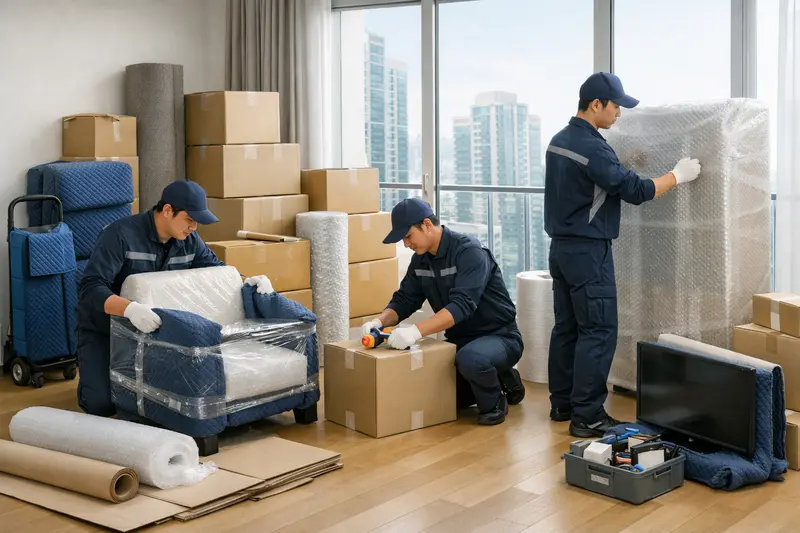
Korean moving companies are built around this expectation. Teams arrive early, pack entire households efficiently, transport everything across the city, and begin unpacking at the new location—all within the same day.
This service, often called “pack-and-move,” turns relocation into a tightly managed process.
Timing matters. The next resident may be waiting for the same apartment only hours later.
Furniture That Travels Through the Air
In many Korean cities, especially in high-rise apartment complexes, furniture does not always move through hallways or elevators.
It moves outside.
A specialized vehicle called a ladder lift raises large items directly from the truck up to a balcony or window. Sofas, wardrobes, and refrigerators appear to float upward along the side of the building.
This method is not unusual.
For tall buildings, it is often faster and more practical than navigating tight elevators or corridors. On busy moving days, several ladder lifts may operate at once, each lifting pieces of someone’s life into a new space.
The Unofficial Food of Moving Day
Inside the apartment, another small tradition often appears.
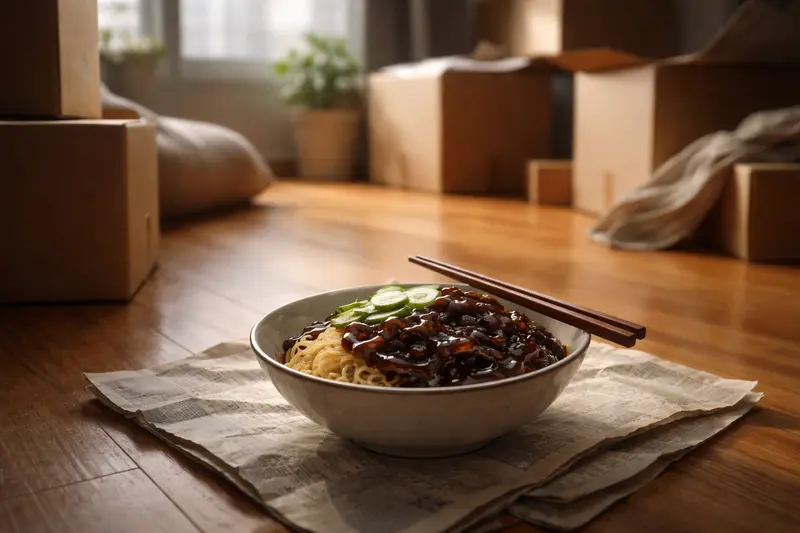
At some point during the move—usually when the kitchen is still packed away—someone orders food. And very often, that food is jajangmyeon.
The black-bean noodles arrive quickly, packed in simple containers. People sit on the floor, surrounded by half-opened boxes, eating between tasks.
It is not ceremonial.
It is practical.
But over time, the repetition has turned it into something recognizable. Jajangmyeon has quietly become associated with moving day itself.
Elevators, Hallways, and Coordination
In apartment complexes, moving is not just a private activity.
It becomes a shared logistical event.
Elevators are reserved in advance. Protective padding is placed along walls and inside elevator cabins to prevent damage. Time slots are sometimes assigned so multiple households can move without interfering with one another.
For a few hours, the building operates differently.
Residents passing through might encounter moving crews, stacked boxes, and furniture waiting in hallways. The usual rhythm of the building pauses and reshapes itself around the process.
Choosing the “Right” Day
Beyond contracts and logistics, there is another layer that sometimes shapes moving schedules.
Some families pay attention to traditional beliefs about auspicious days.
One well-known concept is “Son-eop-neun nal,” often translated as a day when harmful spirits are absent. According to this idea, certain dates in the lunar calendar are considered safer or more favorable for important events, including moving.
Not everyone follows this belief.
But it remains widely recognized. Moving companies often see higher demand on those dates, and some families choose them simply for peace of mind.
When Belief Meets Practical Life
What makes Korean moving day interesting is how these elements overlap.
A modern housing system with fixed contracts. High-rise buildings that require coordinated logistics. Professional moving services designed for speed. And alongside all of that, small traditions and long-standing beliefs.
None of these factors alone explains the pattern.
Together, they create it.
A Neighborhood in Motion
When moving day arrives, it rarely stays contained within one home.
It spreads across the building.
Trucks come and go. Elevators open to reveal padded interiors. Furniture rises slowly along the exterior walls. Inside new apartments, families begin arranging their lives again, one box at a time.
By evening, the activity fades.
The trucks leave. The hallways clear. The building returns to its usual rhythm.
But for a few hours, an entire neighborhood shifts at once—residents leaving one place, others arriving, all connected by the same quiet system of timing and movement.
—
Frequently Asked Questions
Q: Why do so many Korean households move on the same day?
Answer: Rental contracts often begin and end on fixed dates, so one household leaves as another arrives. In large apartment complexes, this creates many moves happening simultaneously.
Q: What is “Son-eop-neun nal,” and do people still follow it?
Answer: It refers to traditionally favorable days believed to be free from harmful spirits. Some families still choose these dates for moving, often for peace of mind rather than strict belief.
Q: What would a visitor actually see on a Korean moving day?
Answer: You would likely see moving trucks, workers carrying boxes, reserved elevators, and sometimes ladder lifts raising furniture outside high-rise buildings. In busy complexes, multiple households may be moving at once.