In many countries, karaoke means standing on a small stage in front of strangers.
One person holds the microphone while everyone else in the bar watches. Some people love the attention. Others avoid karaoke entirely because the idea of performing publicly feels uncomfortable.
In South Korea, karaoke works differently.
Instead of singing in front of a crowd, people usually go to private rooms known as *noraebang* — literally meaning “singing room.”
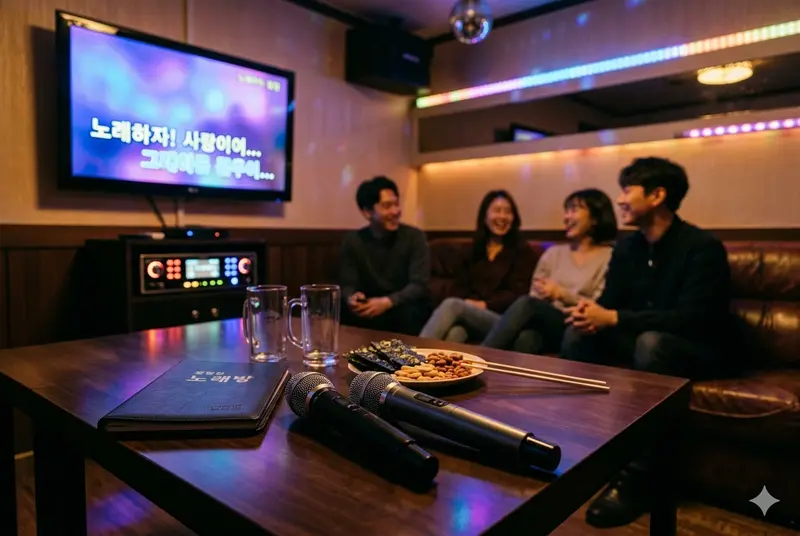
A group of friends enters a small room, closes the door, and sings only for each other.
The difference seems simple, but it changes the entire experience of karaoke.

What a Noraebang Is
A typical Korean noraebang consists of many small rooms arranged along a hallway.
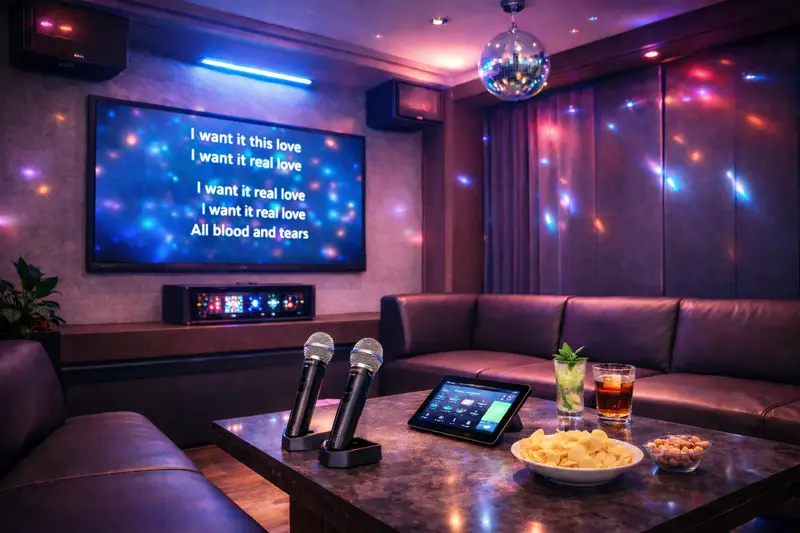
Each room contains:
– microphones
– a large screen displaying lyrics
– a remote control for selecting songs
– speakers and lighting
– couches or bench seating
Customers rent the room for a set amount of time — usually by the hour.
Once inside, the group can sing as loudly, badly, or enthusiastically as they want without worrying about strangers watching.
That privacy turns karaoke into a group activity rather than a performance.
Designed for Groups, Not Audiences
The private-room format reflects how many social activities in Korea are structured.
Instead of interacting with strangers in a shared space, people often socialize in small groups with friends, coworkers, or classmates.
Restaurants use tables for each group.
Cafés are designed for conversation circles.
Even karaoke follows the same pattern.
The focus is not entertaining a room full of people.
It’s simply having fun together.
Why Privacy Matters
The private room format removes one of the biggest barriers to karaoke: embarrassment.
Almost anyone can sing in a noraebang because the audience is limited to friends.
Someone who would never sing in public might still grab the microphone inside a private room.
As a result, participation becomes much higher.
Karaoke turns from a performance into something closer to a shared activity.
People take turns choosing songs, laughing at each other’s attempts, and sometimes singing together.
A Habit That Started Young
For many Koreans, visiting noraebang begins during teenage years.
Students often go after school or while spending time in entertainment districts filled with arcades, snack shops, and karaoke rooms.
In the mid-1990s, when noraebang businesses expanded rapidly across the country, it became one of the most common ways for teenagers to hang out.
For many, it felt almost routine.
How the Business Model Spread
The room-based karaoke concept proved extremely effective.
Small noraebang venues began appearing everywhere — near subway stations, university areas, nightlife districts, and residential neighborhoods.
Operators discovered clear advantages:
– multiple groups can sing simultaneously
– customers feel more comfortable in private
– noise is contained within rooms
Over time, noraebang became one of the most recognizable elements of Korean nightlife.
More Than Nightlife
Despite the association with nightlife, noraebang is used throughout the day.
Students visit after school.
Friends go after dinner.
Office workers stop by during group gatherings.
Because the rooms are private, the experience feels casual.
The goal is not performance.
It’s participation.
Technology and Song Variety
Another reason for noraebang’s popularity is the vast song selection.
Systems are constantly updated with:
– Korean pop songs
– international hits
– classic ballads
– older nostalgic tracks
This allows people of different ages to enjoy the experience together.
Groups often shift between emotional songs, energetic tracks, and nostalgic favorites.
A Different Philosophy of Karaoke
From the outside, Korea’s karaoke system may seem unusual.
But it reflects a broader pattern in Korean social design.
Instead of large shared stages, many experiences are divided into smaller, contained spaces.
Restaurants use group tables.
Study cafés offer individual booths.
Karaoke uses private rooms.
The result is simple.
People participate more when they feel comfortable.
When Entertainment Becomes a Shared Space
Karaoke began globally as a form of public performance.
In South Korea, it became something else.
A small room.
A closed door.
A group of friends.
Inside, the stage disappears.
And the experience becomes something everyone can join.
—
Frequently Asked Questions
Q: If I walk into a Korean karaoke place, what will I actually do first?
Answer: Instead of waiting for a stage, you’ll choose a private room and enter with your group. Once inside, you select songs using a remote and take turns singing in your own space.
Q: Why don’t Korean karaoke places use a public stage like in other countries?
Answer: The system is designed for group comfort rather than public performance. Private rooms remove pressure and make it easier for everyone to participate, even if they are not confident singers.
Q: Is noraebang only for nightlife or drinking culture?
Answer: No. While it’s popular at night, people visit at all times of day. Students, friends, and coworkers all use noraebang casually as a shared activity, not just as part of nightlife.