Right now in South Korea, something interesting is happening.
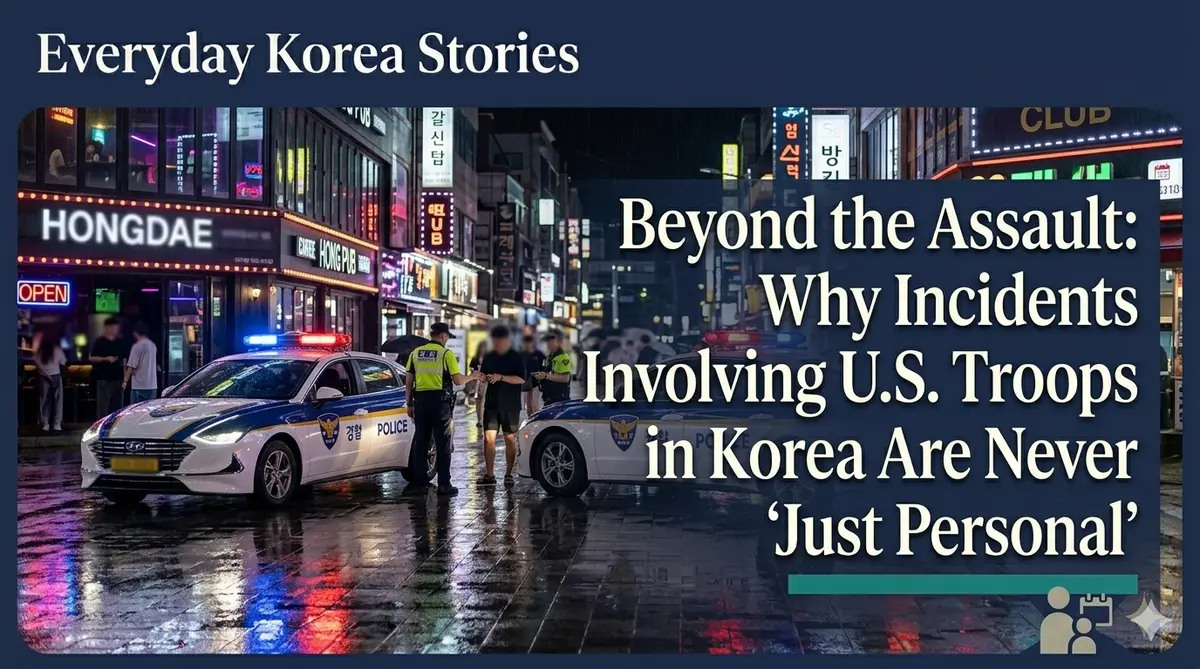
A single late-night altercation in Seoul’s Hongdae district is transforming into a national conversation.
The facts of the case are straightforward: a U.S. servicemember in his 20s allegedly punched a Korean civilian in the face after a verbal dispute. In many cities, this would be a minor police report. In Seoul, it is a catalyst for something much deeper.
To understand the reaction, one has to look past the punch itself—and into what many Koreans describe as a long-standing “justice gap.”
The Living Trauma: The 2002 Yangju Incident
If you ask many Koreans why incidents involving U.S. troops feel different, the answer often goes back to one date: June 13, 2002.
Two middle school girls, Shin Hyo-sun and Shim Mi-sun, were walking along a narrow road in Yangju on their way to a birthday party. Behind them, a 50-ton U.S. military armored vehicle was moving through the area as part of a training exercise.
The road was narrow. The vehicle was wider than the lane.
It struck both girls from behind.
The scale of the impact made the accident immediately fatal.
What followed is what turned the tragedy into something larger.
Because the accident occurred during official duty, the United States retained jurisdiction under the Status of Forces Agreement (SOFA). The case was tried in a U.S. military court, not a Korean one.
The two soldiers were found not guilty of negligent homicide.
There was no prison sentence. No punishment within the Korean legal system. The soldiers returned home.
For many Koreans, the issue was not only the verdict.
It was the absence of a process they recognized.
No Korean court.
No Korean judgment.
No visible accountability within Korean law.
The reaction was immediate and widespread. Candlelight vigils filled central Seoul. Students, office workers, and families gathered not only in mourning, but with a shared sense that something fundamental had failed.
This moment remains one of the strongest reference points in how such incidents are understood today.
The Pattern of “Light Outcomes”
While some may view 2002 as distant history, more recent cases have reinforced a similar perception.
In 2020, a U.S. servicemember assaulted a Korean taxi driver in Hongdae. The attack was unprovoked. The driver suffered injuries requiring weeks of treatment.
The final outcome was a fine of approximately 5 million KRW.
In isolation, this is a legal penalty.
In public perception, it feels different.
A violent assault resulting in a relatively small financial penalty creates the impression that punishment is limited in scope—more transactional than punitive.
In 2021, another case in Mapo added to this perception.
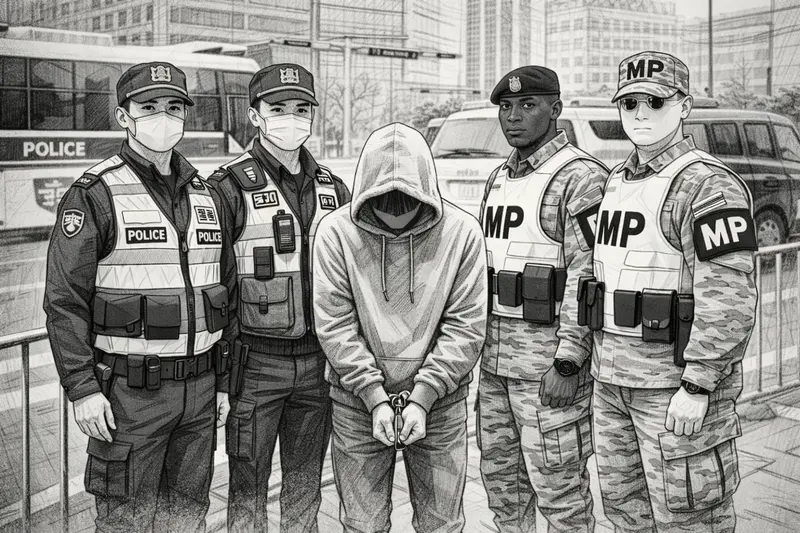
A U.S. servicemember was detained near the scene of an alleged sexual assault. However, under SOFA procedures, custody remained with the U.S. military for much of the investigative process.
The suspect was transferred to a U.S. base.
From a legal standpoint, this follows established protocol.
From a public standpoint, it creates a different impression.
The physical transfer—from Korean police custody to a U.S. military base—feels like a boundary.
A point where the reach of Korean law appears to stop.
And when cases later result in suspended sentences or limited prison time, that perception becomes stronger.
The “Justice Gap” as a Lived Perception
Over time, these cases form a pattern in public consciousness.
Not necessarily identical outcomes, but a consistent structure:
A crime occurs.
Jurisdiction becomes complicated.
The outcome feels lighter than expected.
This is what many Koreans describe as the “justice gap.”
When a Korean citizen commits a crime, the process is visible, familiar, and contained within a single legal system.
When a U.S. servicemember is involved, the process becomes layered.
Custody may shift.
Jurisdiction may be divided.
The final outcome may feel distant from the initial event.
The public sees the moment of transfer—the handover to U.S. military police.
But they rarely see the full process that follows.
That gap between visibility and outcome becomes part of the perception.
How People Are Reacting Now
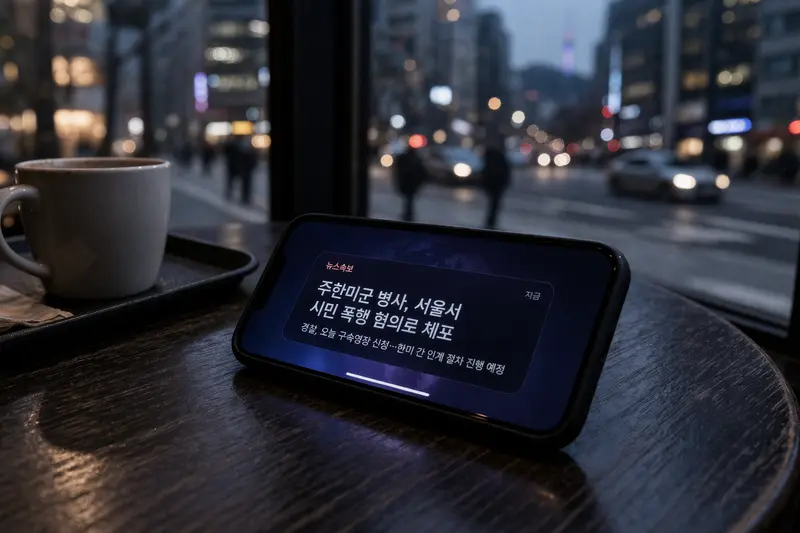
In the Hongdae case, this accumulated perception appears immediately.
Searches for “SOFA” rise.
Users share explanations of jurisdiction rules.
Past incidents are reposted alongside current headlines.
On platforms like Naver and community forums, the discussion moves quickly beyond the incident itself.
The focus is not only on what happened.
It is on what is likely to happen next.
Two “Armies” in the Same City
At the same time, another scene has unfolded in Seoul.
In Gwanghwamun, BTS fans—known as ARMY—have gathered in large numbers, turning the city purple.
The atmosphere is celebratory, collective, and highly visible.
At the same time, the word “army” appears in a different context.
The U.S. military.
The contrast is subtle, but difficult to ignore.
One “ARMY” represents cultural influence and global connection.
The other represents a military presence tied to legal structures and historical memory.
Both exist in the same city.
But they carry entirely different meanings.
A Debt of Fairness
The current Hongdae incident may ultimately result in a fine or a limited sentence.
But within Korea, it will not be understood as an isolated case.
Each incident is layered onto previous ones.
Each outcome is compared to what people believe would happen under different circumstances.
And each time, the same question returns:
Does the system produce equal consequences?
In Seoul, a single punch can become something larger.
Not because of the act itself.
But because of everything that surrounds it.
Frequently Asked Questions
Q: Why is the 2002 Yangju incident still so influential today?
Answer: It established a lasting perception that serious incidents involving U.S. troops could be handled outside the Korean legal system, leaving many people feeling that justice was incomplete.
Q: What is the main issue Koreans have with SOFA?
Answer: The concern is not the agreement itself, but how it is applied. When jurisdiction or custody limits Korean legal authority, it can create a perception of unequal treatment.
Q: Why do smaller incidents still trigger strong reactions?
Answer: Because they are not viewed in isolation. Each case is interpreted through past examples, which amplifies its meaning beyond the immediate event.