The first step into a Korean apartment rarely feels like a normal step.
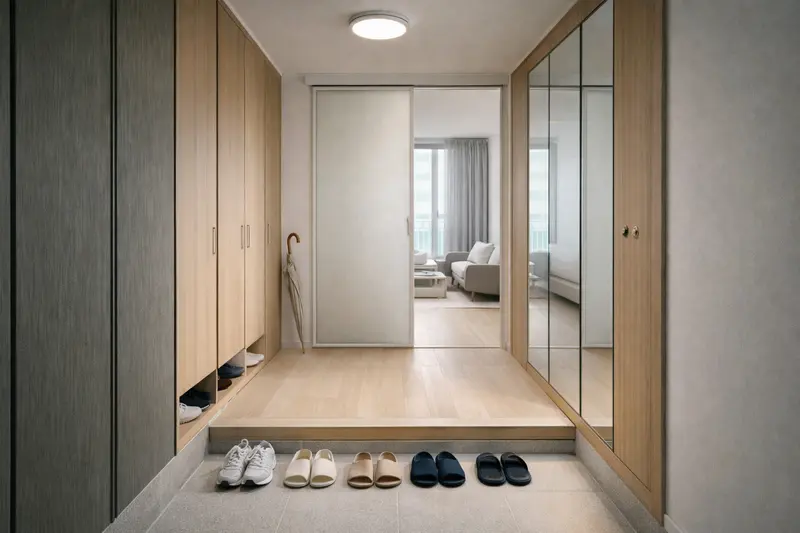
The door opens, and instead of walking straight in, your foot lands on a slightly lower surface. Shoes come off almost instinctively. Then, one small movement — stepping up — brings you into the living space.
No one needs to explain what just happened.
The space did it for you.
This lowered entry area, known as the hyun-gwan, looks like a minor architectural detail. But it quietly controls one of the most repeated behaviors in Korean daily life.
It tells you where the outside ends — and where home begins.

A Boundary You Feel, Not Read
The most interesting thing about the hyun-gwan is how little it relies on instruction.
There are no signs telling you to remove your shoes. No reminders posted on the wall.
Instead, the floor simply drops.
That physical change creates a moment of pause. You don’t walk through it casually. You notice it. And almost without thinking, you respond correctly.
Shoes stay below.
Living space begins above.
It’s a rule embedded in the structure itself.
In that sense, the entryway doesn’t just separate spaces — it trains behavior.
Why Korean Homes Need This Boundary
The importance of that boundary becomes clearer once you understand how the inside of a Korean home is used.
Floors are not just surfaces for walking.
People sit on them.
Children play on them.
Families sometimes eat or sleep on them.
And because of the ondol heating system, the floor is often the warmest, most comfortable place in the house during winter.
That changes everything.
If outdoor shoes were allowed inside, the main living surface of the home would quickly become dirty and uncomfortable.
The hyun-gwan prevents that problem before it starts.
A System Designed for Repetition
What makes this design effective is not just the idea — it’s the repetition.
People enter and leave their homes multiple times a day.
Every time, they encounter the same sequence:
Step in.
Pause.
Remove shoes.
Step up.
Over time, the action becomes automatic.
Children learn it without being taught. Guests follow it without being told.
The architecture removes the need for social enforcement.
It replaces reminders with structure.
The Hidden Role of Urban Density
This design also makes more sense when viewed inside Korea’s dense urban environment.
Most people live in apartment buildings, where hundreds of households share the same vertical space. Hallways, elevators, and entrances connect large numbers of residents.
In that context, cleanliness is not just a personal preference — it’s part of maintaining a shared system.
Outdoor dirt doesn’t stay outside for long if it’s carried through multiple units.
The entryway acts as a filter.
It ensures that what enters the home from a dense, shared environment stops at the door.
A Smaller Version of Something Much Older
Although the hyun-gwan feels modern, the idea behind it is not new.
Traditional Korean houses, known as hanok, used a much larger transition space.
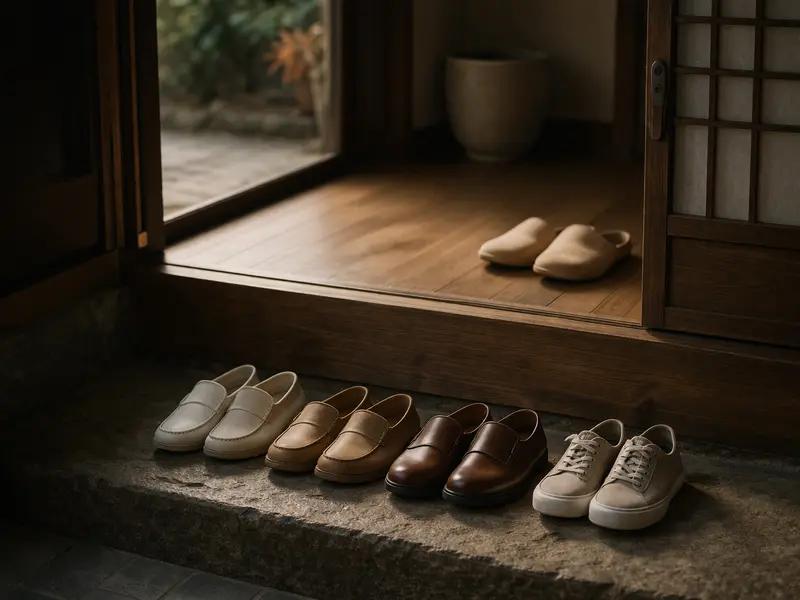
Before entering the interior rooms, people passed through an open courtyard called the madang. From there, they stepped up onto raised wooden floors.
The sequence was similar:
Outside → transitional space → raised interior
The difference is scale.
Modern apartments compress that entire process into a few centimeters of height change.
The courtyard disappears.
The concept remains.
Why It Feels Unusual to Visitors
For many visitors, the design stands out immediately.
In countries where shoes are commonly worn indoors, the boundary between outside and inside is less defined. Floors are treated as surfaces for walking, not living.
Without a physical transition, the expectation to remove shoes depends more on personal habit than built structure.
In Korea, the expectation is built into the space itself.
You don’t need to ask what to do.
The floor already answered.
When Architecture Replaces Rules
The hyun-gwan is a good example of how Korean living systems often work.
Instead of relying heavily on verbal instructions or enforcement, small design decisions guide behavior.
A lowered floor replaces a written rule.
A step replaces a reminder.
Over time, the behavior feels natural — not because people are told to follow it, but because the space makes alternatives feel awkward.
That’s why the system works so consistently.
A Small Step That Organizes Daily Life
It’s easy to overlook the entryway.
It occupies only a few square feet. It’s used for a few seconds at a time.
But it shapes one of the most repeated actions in the home.
Every time someone enters, they pause. Remove their shoes. Step up.
That small sequence quietly separates two worlds.
Not with a wall.
Not with a sign.
Just with a step.
—
Frequently Asked Questions
Q: Why is the entrance floor lower in Korean apartments?
Answer: The lowered entryway creates a clear physical boundary where people remove their shoes before stepping into the clean living space. It prevents outdoor dirt from entering areas where people sit and live.
Q: Do people always have to take off their shoes in Korea?
Answer: Yes, in almost all homes. The entryway design reinforces this expectation, so both residents and visitors naturally follow the rule without needing reminders.
Q: Is this design related to traditional Korean houses?
Answer: Yes. Traditional homes used courtyards and raised floors to create a similar transition between outside and inside. Modern apartments compress that idea into a small entry step.