Late at night in Seoul, a certain kind of room stays quietly active.
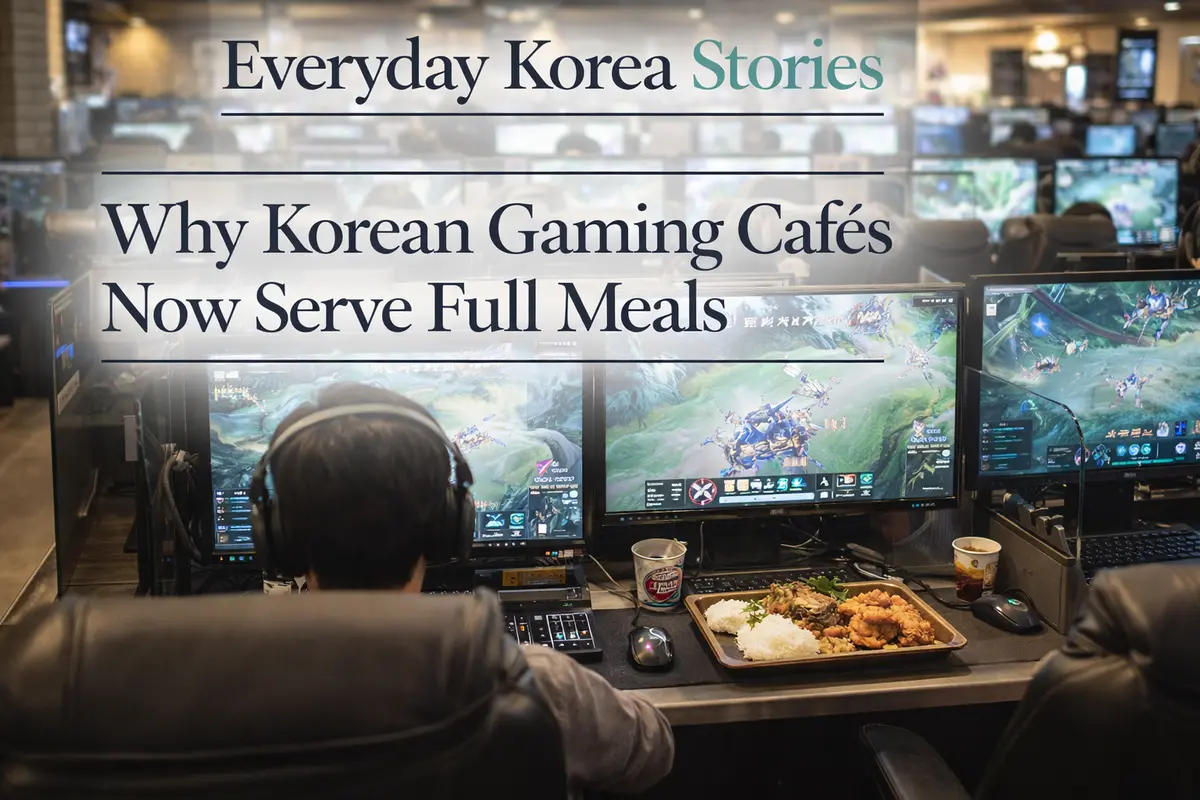
Rows of glowing monitors. The soft clicking of keyboards. Someone leaning forward in concentration while a tray of hot food sits beside the mouse.
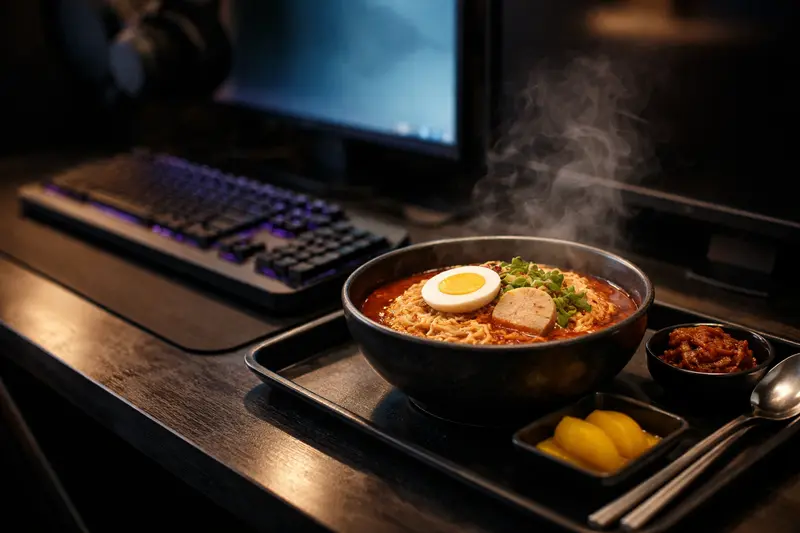
Steam rises from a bowl of ramen.
No one leaves their seat.
In South Korea’s PC bangs, eating and gaming have merged into a single routine — one that didn’t exist in quite the same way a decade ago.
What a PC Bang Actually Is
A PC bang (pronounced “pee-see bang”) is a public gaming space where customers rent high-performance computers by the hour.
These venues first became popular in the late 1990s, when home computers were expensive and internet speeds varied widely. PC bangs offered something better:
* faster internet
* more powerful machines
* a place to play together
For many young people, they became a social anchor — somewhere between a café and a clubhouse.
Even as home setups improved, PC bangs didn’t disappear.
They adapted.
When Competition Changed the Business
At some point, simply offering good computers wasn’t enough.
In dense neighborhoods, multiple PC bangs could exist within walking distance of each other. The difference between staying full and losing customers came down to small details.
One of those details was time.
The longer someone stayed, the more revenue the business generated.
That created a simple question for operators:
How do you keep people from leaving?
Food became the answer.
From Snacks to Full Menus
Early PC bangs offered basic options — instant noodles, packaged snacks, drinks.
Then menus started expanding.
Not dramatically at first. Just small additions.
But over time, something shifted.
Today, many PC bangs serve meals that resemble casual restaurant menus:
* freshly prepared ramen
* fried rice
* meat-based rice bowls
* dumplings and snacks
* fried chicken
* simple pasta dishes
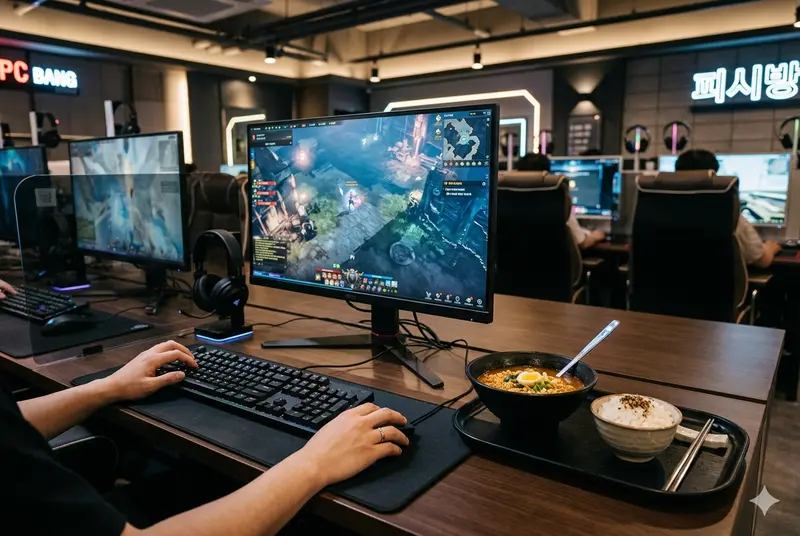
Orders are placed directly through the computer screen.
A few minutes later, the food arrives at the desk.
No need to pause the game.
Eating Without Leaving the Game
What makes this system work is how seamlessly it fits into the environment.
PC bangs are designed for long sessions.
Large chairs. Dim lighting. Screens positioned close enough to block out distractions. Everything encourages staying in place.
Leaving to find food would break that rhythm.
So the system removes the need to leave.
Players eat between matches. During loading screens. Sometimes with one hand still on the mouse.
The boundary between “gaming time” and “meal time” disappears.
The Taste Profile Tells You Who It’s For
Ask parents about PC bang food, and you’ll often hear a similar reaction.
At first, they assume it’s basic.
Then they try it.
And they notice something immediately — the flavor.
Stronger seasoning. Sweeter sauces. Heavier salt. Designed to be instantly satisfying.
It’s food optimized not for balance, but for appeal during long, late hours.
In other words, it’s built for the people sitting in those chairs.
A Business Built on Staying Power
From the outside, serving food in a gaming café might look like an extra feature.
Inside the business model, it’s central.
Every additional hour a customer stays increases revenue.
Food does two things:
1. It removes the reason to leave
2. It creates additional spending inside the space
Instead of losing customers to nearby restaurants, PC bangs absorb that demand.
The result is a self-contained environment where time — not just gaming — is monetized.
A Social Space That Doesn’t Look Like One
PC bangs are often quiet.
People sit side by side, focused on screens, wearing headphones.
But they are still social spaces.
Friends arrive together. Groups coordinate games. Conversations happen in short bursts between matches.
Adding food changes the dynamic slightly.
A table isn’t needed. The desk becomes enough.
A shared meal happens without anyone moving.
That subtle shift turns the space into something closer to a hybrid between a gaming lounge and a casual restaurant.
Why This Didn’t Happen Everywhere
In many countries, internet cafés faded because home setups became sufficient.
In Korea, several conditions kept PC bangs alive:
* extremely fast internet infrastructure
* strong multiplayer gaming culture
* dense urban environments
* social habits built around shared spaces
Once those spaces remained relevant, adding food became a logical next step.
The infrastructure was already there.
The behavior just expanded.
When Entertainment Expands Into Daily Life
The evolution of PC bangs reflects a broader pattern in Korean cities.
Spaces rarely stay single-purpose for long.
A place to study becomes a place to work.
A convenience store becomes a place to eat.
A gaming café becomes a place to have dinner.
Functions overlap because time is compressed.
People look for ways to do more without moving between places.
PC bang meals are one small example of that shift.
Frequently Asked Questions
Q: Do people really eat full meals at PC bangs in Korea?
Answer: Yes. Many PC bangs offer full menus, and it’s common for customers to eat complete meals during long gaming sessions without leaving their seats.
Q: How do you order food at a PC bang?
Answer: Orders are usually placed through the computer interface. Customers select items from a digital menu, and staff deliver the food directly to their desk.
Q: Is PC bang food considered high quality?
Answer: It’s generally designed for convenience and strong flavor rather than fine dining. The focus is on quick, satisfying meals that suit long gaming sessions.