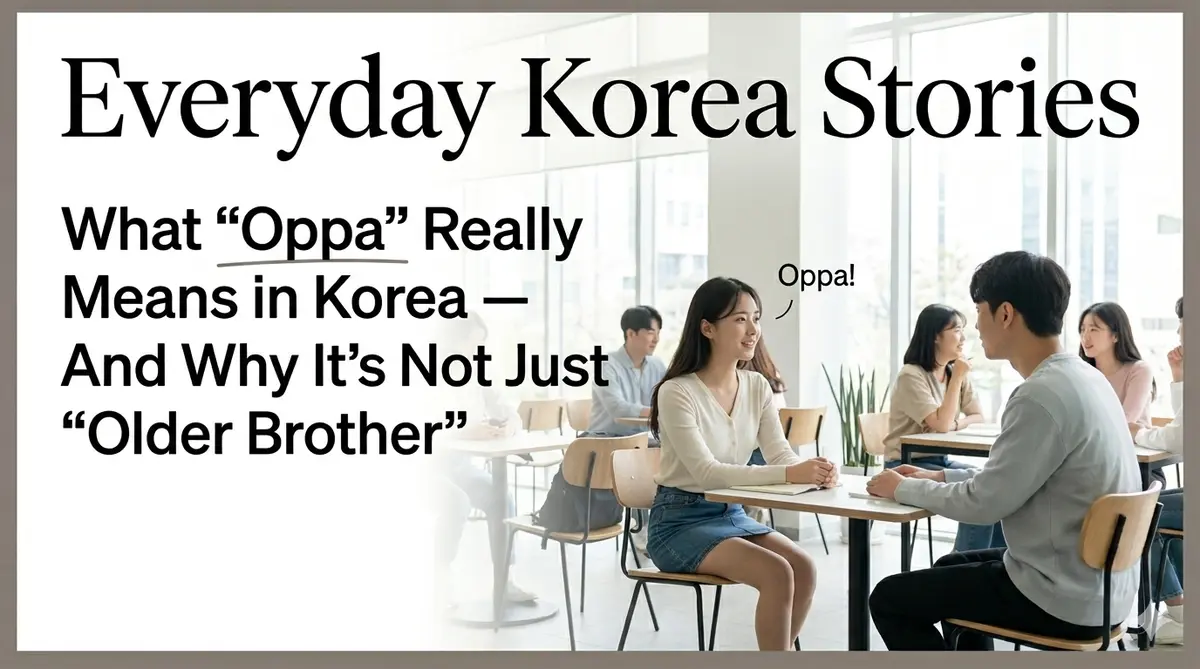
In a university café in Seoul, the air is thick with overlapping conversations and the low hum of espresso machines.
At one table, a group of students lean in close, half studying, half talking. Someone laughs. A phone lights up. Chairs scrape softly against the floor.
From across the room, a voice cuts through the noise.
“Oppa!”
A man looks up immediately, as if the word had been aimed precisely at him.
Moments later, the same woman gestures toward another slightly older student — but this time, she uses a different word.
“Sunbae.”
To someone unfamiliar with Korean, the difference might seem minor. Just two ways of addressing someone older.
But inside that small shift is an entire layer of social meaning — about closeness, distance, and the subtle boundaries between them.
Why “Oppa” Is More Than “Older Brother”
On paper, “oppa” translates simply: a woman addressing an older male.
In practice, the word rarely stays that simple.
It moves.
A woman might use it for her actual brother at home. Later that day, she might use the same word for a close male friend. In another context, it becomes the way she addresses her boyfriend — sometimes without ever needing another term.
Nothing about the word changes.
Everything about the relationship does.
English tends to separate roles clearly. Family is one category. Romance is another. Friendship sits somewhere else entirely.
Korean allows those lines to blur, but not randomly. The word adapts to the relationship, carrying tone rather than fixed meaning.
That is why translating “oppa” directly always feels slightly off.
The Line Between “Oppa” and “Sunbae”
On a university campus, the distinction becomes easier to see.
“Sunbae” is stable. It signals hierarchy — someone who entered earlier, someone more experienced. It is respectful, neutral, and safe.
It does not imply closeness.
“Oppa” does something different. It softens the structure. It brings the relationship slightly closer, even if only by a small degree.
Sometimes that shift is obvious. Sometimes it is barely noticeable.
And sometimes, it becomes the subject of a familiar joke among students:
If he’s attractive, he’s “oppa.” If not, he remains “sunbae.”
The joke lands because it reflects something people recognize but rarely state directly.
“Oppa” is not assigned only by age.
It is granted through perception — through comfort, familiarity, and sometimes quiet interest.
A Word That Signals Emotional Distance
In everyday interactions, Koreans are constantly adjusting language to match relationships.
A slight change in wording can signal a shift in distance — closer, or further away.
“Oppa” sits in a delicate position within that system.
It suggests:
Not too formal.
Not too distant.
Not entirely neutral.
There is room inside it for warmth.
That does not mean it is always romantic. Far from it.
But it leaves space for something more personal than a purely hierarchical term.
When “Oppa” Becomes Affection
In romantic relationships, the tone shifts again.
Between couples, “oppa” often replaces names entirely. It becomes the default way of addressing a partner — not because it literally means “brother,” but because it carries familiarity and ease.
To an outsider, this can feel contradictory.
Why use a family term in a romantic context?
But inside Korean language structure, the word no longer belongs to the family category once it moves into that space. It becomes something else — closer to a soft, everyday form of affection.
Not quite “honey.” Not quite “baby.”
Something quieter. More embedded.
The Social Logic Behind It
Korean language does not prioritize fixed definitions. It prioritizes relationships.
Age, hierarchy, and emotional closeness all shape how people speak to each other. Words adjust accordingly.
That is why “oppa” cannot be understood in isolation.
It only makes sense when placed inside a relationship:
Who is speaking.
Who is being addressed.
What exists between them.
Without that context, the word feels ambiguous.
With it, the meaning becomes precise.

Why It Confuses Outsiders
For non-Korean speakers, the instinct is to translate.
To find a direct equivalent. To anchor the word to something familiar.
But “oppa” resists that process.
It is not a label that fits neatly into a dictionary category. It behaves more like a signal — one that shifts depending on the situation.
Trying to define it too narrowly misses how it actually functions.
Understanding it requires a different approach.
Not asking, “What does this word mean?”
But asking, “What does this word reveal about the relationship?”
A Small Word That Carries Social Awareness
Back in the café, nothing about the scene stands out dramatically.
People continue talking. Drinks are refilled. Someone opens a laptop.
But the choice between “oppa” and “sunbae” lingers quietly in the background.
It tells you something about how people see each other.
Not loudly. Not directly.
But clearly enough, if you know what to listen for.

Frequently Asked Questions
Q: Is it weird to call your boyfriend “oppa”?
Answer: Not at all. It is very common in Korea. In that context, “oppa” no longer feels like “brother” — it functions as a natural and familiar way to address someone older that you are close to.
Q: Can men use “oppa”?
Answer: No. “Oppa” is used only by women when addressing older males. Men would use different terms, such as “hyung,” for older male friends or relatives.
Q: Should foreigners use “oppa”?
Answer: It depends on the relationship. When used naturally within the right context, it can feel appropriate. But using it casually without understanding the nuance may come across as awkward or performative.