On a busy street in Seoul, it’s easy to walk past one without noticing at first.
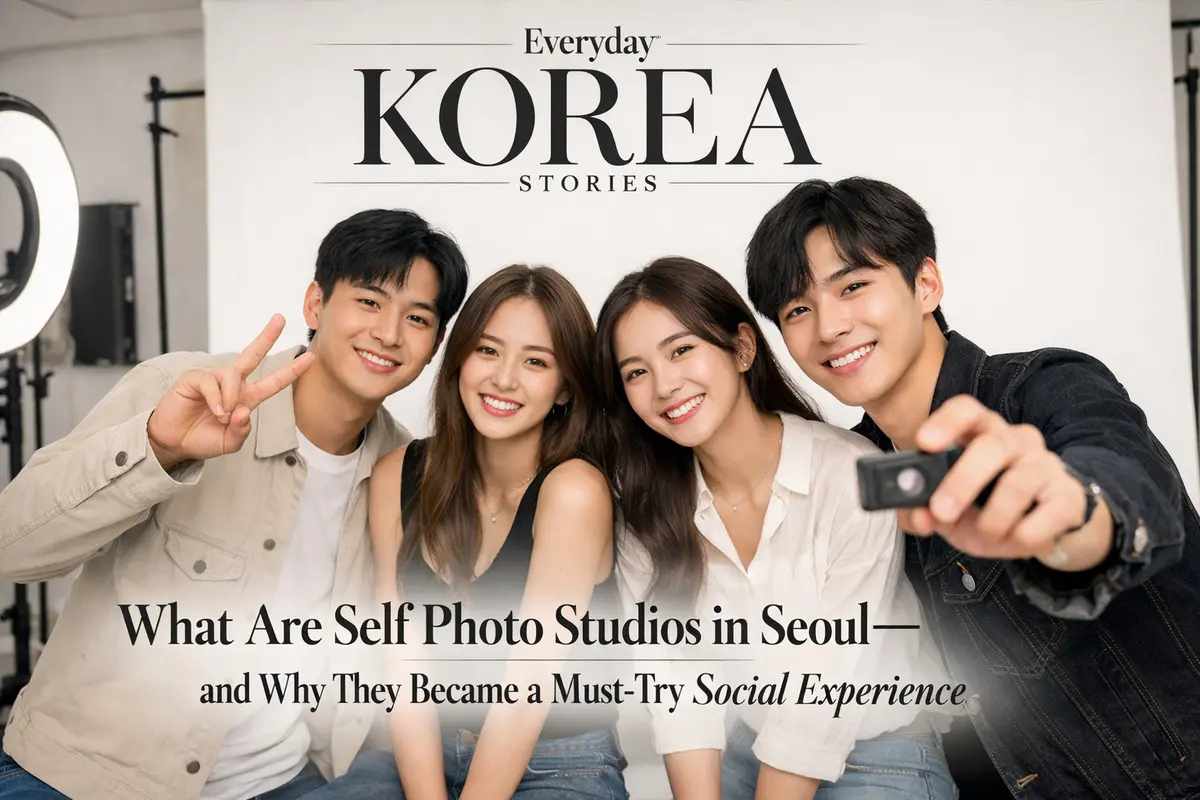
A small glass-front studio. Bright white lighting inside. A group of friends crowding together, laughing as they take turns pressing a remote shutter.
No photographer. No instructions.
Just a countdown, a burst of laughter, and a flash.
If you’re visiting Seoul, you might notice these spaces almost by accident — often between a café and a subway station, or tucked into a busy shopping street.
And within minutes, people who had no plan to take photos find themselves stepping inside.
What looks like a simple photo session is, in reality, one of the most recognizable small rituals in Korean social life.
From Photo Booth to Self-Controlled Studio
The idea didn’t begin with studios.
For years, small instant photo booths — especially brands like *Life Four Cuts* — were already part of everyday life in Korea. You could find them near subway stations, shopping streets, and university areas.
They were quick, simple, and social.
But they were also limited.
You had only a few seconds. A fixed frame. Almost no control.
Self photo studios emerged as a natural extension of that experience.
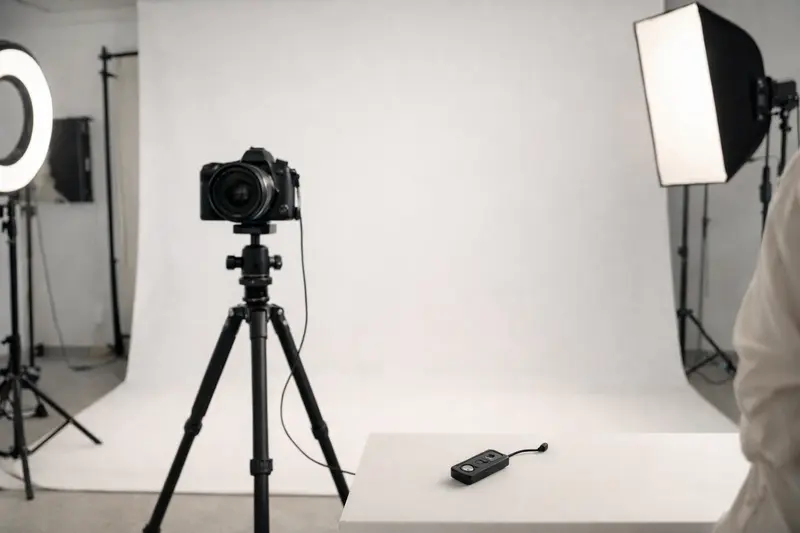
Instead of squeezing into a booth, people now step into a small, private studio equipped with:
– pre-set professional lighting
– high-resolution cameras
– simple backdrops
– a remote shutter
Nothing needs to be adjusted.
You walk in, pick up the remote, and start.
The difference is subtle, but important.
The camera no longer belongs to a photographer. It belongs to the people in the room.
What Actually Happens Inside
The process is less formal than many expect.
A group walks in — often without planning. Sometimes after dinner. Sometimes while walking through a busy neighborhood.
They choose a background. Place their bags to the side. Someone picks up the remote.
Then the rhythm begins:
– countdown
– pose
– laughter
– reset
– repeat
If you try it yourself, you’ll notice something quickly.
At first, the poses are careful.
Then they loosen.
Within a few minutes, people stop trying to look perfect and start trying to make each other laugh.
Someone jumps. Someone leans too far. Someone presses the button too early.
And those are often the photos they keep.
Designed for Groups, Not Individuals
Unlike traditional studios, these spaces are not built around a subject.
They are built around interaction.
That’s why most visits happen in groups:
– friends celebrating a birthday
– classmates after an exam
– couples on a date
– travelers exploring a new area
No one is directing the session.
The group negotiates everything — poses, timing, expressions.
This shifts the purpose of photography.
The goal is no longer just to produce a good image.
It’s to create a shared moment.
The Humor That Emerges
Over time, certain patterns appear.
One of the most common is a playful imbalance within the group.
One person stands still in the center.
Everyone else exaggerates — wide eyes, distorted expressions, dramatic gestures.
Among friends, this kind of joke is sometimes casually described as “face sacrifice.”
The humor isn’t in looking good.
It’s in contrast, timing, and how far someone is willing to go for the group.
These patterns aren’t instructed.
They emerge naturally — repeated across different groups, different cities, different moments.
Why It Feels Different
Part of the appeal comes from the absence of pressure.
There is no photographer watching.
No one correcting posture.
No expectation of perfection.
Because the system is automated, the space feels private — even though it is designed for sharing.
People behave differently in that environment.
They experiment more.
They take more risks.
And they often take more photos than they intended.
A Stop Along the Way
Self photo studios are rarely the main destination.
They appear between things.
Between dinner and dessert.
Between shopping and heading home.
Between walking and deciding where to go next.
You notice one. You walk in.
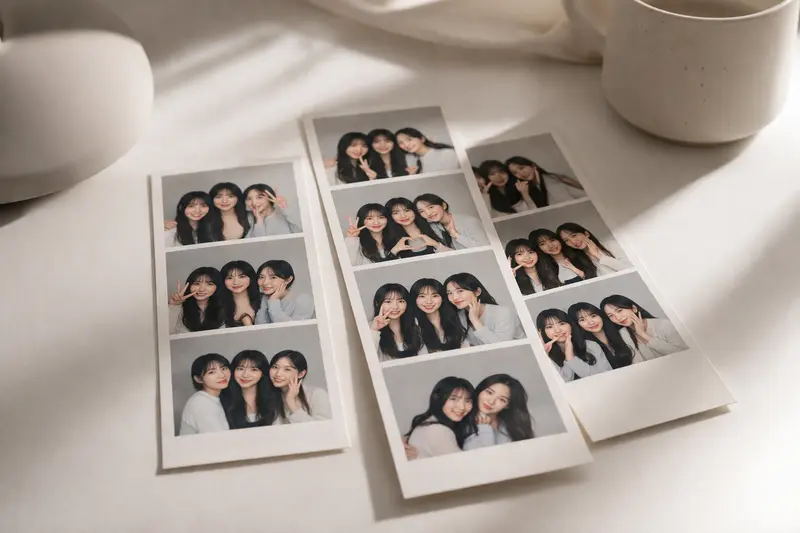
Fifteen minutes later, you leave with a set of printed photos.
They become a small record of a specific moment — not planned, but still preserved.
Why It Fits Korean Social Life
In dense urban environments like Seoul, people are constantly moving between small, shared spaces.
Cafés, convenience stores, study rooms, karaoke booths.
Self photo studios fit naturally into this ecosystem.
They are:
– small
– fast
– repeatable
– easy to enter and exit
More importantly, they require no preparation.
That makes them compatible with how social plans often unfold — loosely, spontaneously, and in groups.
Not Just a Photo, But a Pattern
At first glance, self photo studios might look like a simple upgrade from photo booths.
But the change is deeper.
The photographer is gone.
The timing is controlled by the participants.
The goal shifts from image quality to shared experience.
Photography becomes something people do together, not something done for them.
Frequently Asked Questions
Q: Do you need photography skills to use a self photo studio in Korea?
Answer: No. The lighting and camera are already configured. Users simply control the timing with a remote shutter, making it easy for anyone to take high-quality photos without technical knowledge.
Q: How long does a typical session last?
Answer: Most sessions last around 10 to 20 minutes. The short time encourages quick decisions, spontaneous poses, and a more playful experience overall.
Q: Is this something tourists can easily try in Seoul?
Answer: Yes. Self photo studios are widely available in popular areas, and the process is simple enough for first-time visitors to use without any preparation.
When the Camera Becomes Part of the Group
In many places, the camera still stands apart from the people it captures.
In these studios, it doesn’t.
The camera waits where everyone can reach it.
The timer counts down for everyone at once.
The moment belongs to the group, not the device.
And for a few seconds, each time the button is pressed,
the photograph isn’t just being taken.
It’s being made together.