The sound comes before you see it.
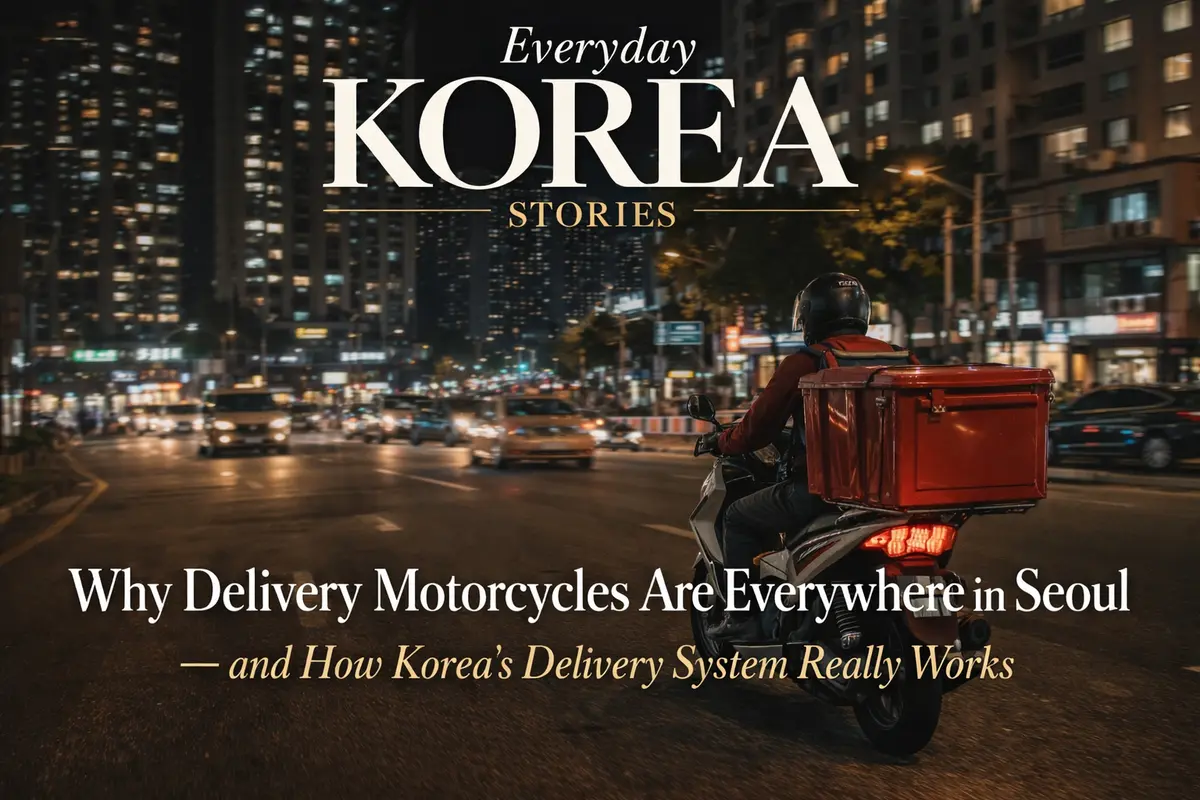
A low engine hum cuts through the evening air. Then a motorcycle passes, a large delivery box secured to the back, turning quickly into a narrow street between apartment buildings.
A few seconds later, another one follows.
Then another.
At first, it feels like coincidence. But after a few minutes, a pattern becomes clear. The motorcycles are not random. They are constant.
In Korean cities — especially around dinner time — they are part of the background.
They are how meals move.
If you spend even one evening in Seoul, this is something you start to notice almost immediately.
A System Designed for Density, Not Distance
To understand why delivery motorcycles are everywhere in Korea, it helps to look at the structure of the city itself.
Korean cities are dense in a way that changes how logistics work.
Restaurants, apartment complexes, office buildings, and small shops are often located within a few blocks of each other. A single neighborhood can contain thousands of potential customers within a short radius.
At the same time, many streets are narrow, especially in residential areas. Cars can pass, but not always efficiently. Parking is limited. Traffic builds quickly during peak hours.
In this environment, large delivery vehicles become inefficient.
Motorcycles, however, fit perfectly.
They move through tight streets. They stop directly in front of buildings. They turn quickly and leave just as fast.
The system is not just fast.
It is adapted to the shape of the city.
Before Apps, There Were Already Riders
Food delivery in Korea did not begin with smartphones.
Long before apps existed, certain foods were already expected to arrive by motorcycle.
A customer would call a restaurant directly. The order would be taken over the phone. A rider would arrive minutes later, carrying stacked metal containers balanced carefully behind them.
Some of the most common delivery foods were consistent across decades:
– jajangmyeon (black bean noodles)
– fried chicken
– pizza
– late-night snacks
The infrastructure already existed.
The motorcycle was already there.
What changed later was not the idea of delivery — but the scale of it.
From Phone Calls to Platforms
The introduction of delivery apps transformed the system from individual restaurant service into a connected network.
Platforms like Baemin or Coupang Eats allow users to browse dozens, sometimes hundreds, of nearby restaurants at once.
Instead of asking one restaurant if they deliver, users scroll through options, compare menus, check reviews, and place an order within seconds.
The app then assigns a rider.
If you try ordering in Korea, you’ll notice how quickly this process becomes routine.
This small shift changed behavior in a fundamental way.
Delivery stopped being a feature of certain restaurants and became a standard expectation across the entire food landscape.
The Pandemic Acceleration
The system expanded rapidly during the COVID-19 pandemic.
As dining inside restaurants became restricted, delivery moved from convenience to necessity.
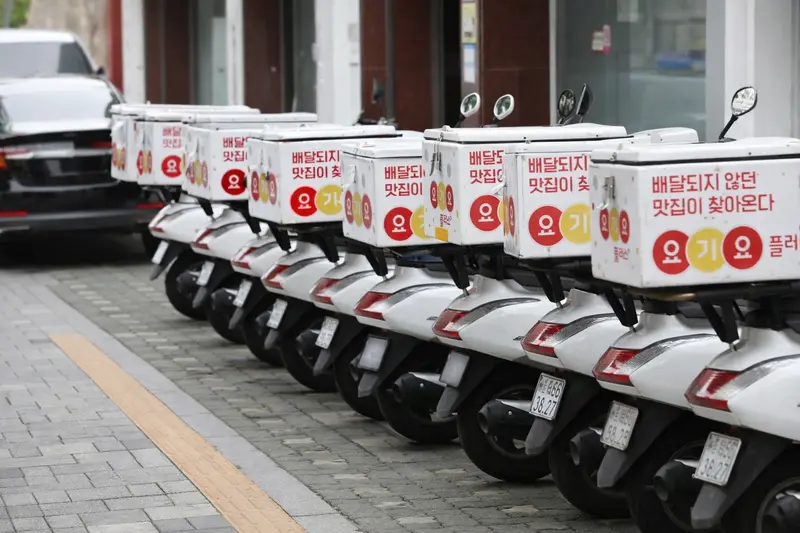
Restaurants that had never considered delivery joined platforms. Small businesses adapted quickly. More riders entered the system to meet demand.
What had been growing steadily suddenly accelerated.
In many neighborhoods, the increase was visible.
More motorcycles. More riders waiting outside restaurants. More movement at all hours of the day.
The network became denser.
The Shift in Expectation
One of the most subtle but important changes happened in how people think.
In the past, delivery was limited. Some foods were simply not expected to travel.
Now, the assumption has flipped.
Instead of asking, *“Do they deliver?”*, people ask, *“Is it on the app?”*
That difference matters.
It means delivery is no longer tied to individual restaurants. It is tied to the system itself.
If a restaurant is connected to the platform, it becomes part of the delivery network by default.
And increasingly, most are.
Why Motorcycles Still Dominate
Even as the system becomes more digital, the physical movement of food still depends on one key factor: speed.
Motorcycles remain dominant because they solve several problems at once.
They are fast over short distances. They are easy to park. They can handle frequent stops without slowing down the overall system.
For delivery, especially in dense cities, capacity matters less than turnaround time.
A single rider completing multiple fast deliveries is more efficient than a larger vehicle moving slowly.
Motorcycles optimize for exactly that.
Apartment Living Makes It Work
Another piece of the system comes from how people live.
Korea’s housing is heavily centered around apartment complexes.
A single building can contain dozens, sometimes hundreds, of households stacked vertically in one location.
For delivery riders, this creates efficiency.
Instead of traveling long distances between customers, multiple deliveries can be completed within the same complex. Elevators replace distance. Density replaces travel time.
If you live in one of these buildings, you’ll quickly notice how frequently riders come and go.
The structure of housing and the structure of delivery reinforce each other.
A Network You Can Hear
Unlike many forms of infrastructure, this one is visible — and audible.
You do not need to look at data to understand it.
You hear it.
The engine passing by. The quick stop in front of a building. The sound fading as the rider leaves for the next destination.
It happens repeatedly, throughout the day.
Lunch hours. Dinner time. Late night.
The pattern does not stop.
Convenience That Became the Default
Over time, something else changed.
Delivery stopped feeling like a special option.
It became normal.
Opening an app, placing an order, and waiting a short time for food to arrive is now a routine part of daily life for many people in Korean cities.
The system is reliable enough that it fades into the background.
Until you start noticing the motorcycles again.
The Invisible System Behind Everyday Meals
From a distance, the system is easy to overlook.
There are no central hubs. No visible control centers. No single place where everything connects.
But on the ground, it is constantly in motion.
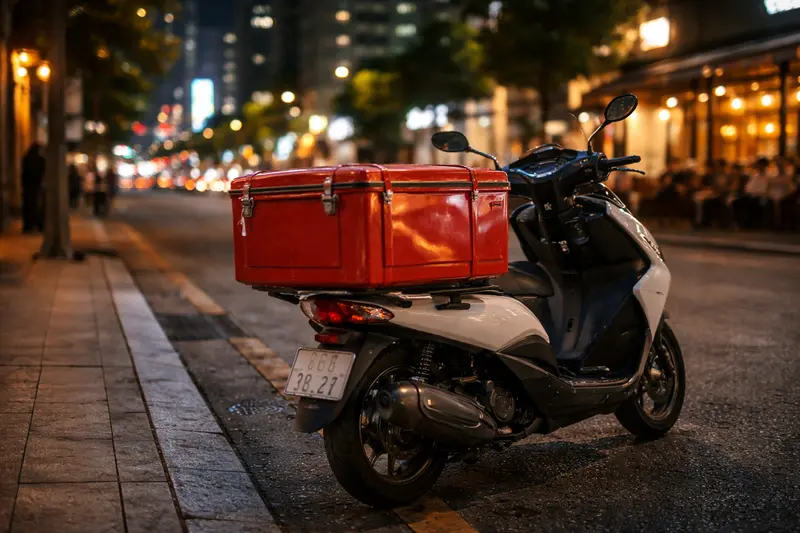
Riders move between restaurants and homes. Orders are picked up, transported, delivered, and replaced by the next.
It is a network built not from large structures, but from thousands of small movements happening at the same time.
And together, they form one of the most efficient urban delivery systems in the world.
Frequently Asked Questions
Q: Why are motorcycles used instead of cars for delivery in Korea?
Answer: Motorcycles are faster and more flexible in dense urban environments. They can navigate narrow streets, avoid traffic congestion, and park easily near buildings, making them ideal for short-distance delivery.
Q: Did Korea always have food delivery before apps like Baemin?
Answer: Yes. Many restaurants offered phone-based delivery for decades, especially for foods like jajangmyeon and fried chicken. Apps expanded this existing system rather than creating it from scratch.
Q: As a visitor, why do I see so many delivery motorcycles in Seoul at night?
Answer: Dinner time is one of the busiest periods for food delivery. High density and strong demand mean many riders are active at the same time, making the system highly visible.