
Right now in South Korea, something interesting is happening.
Across Seoul, café menus are quietly changing. Desserts that were trending just weeks ago are already disappearing, replaced by something new—something simpler, more local, and noticeably more adaptable.
The shift is happening so quickly that many customers barely notice it.
But café owners do.
What Is Happening
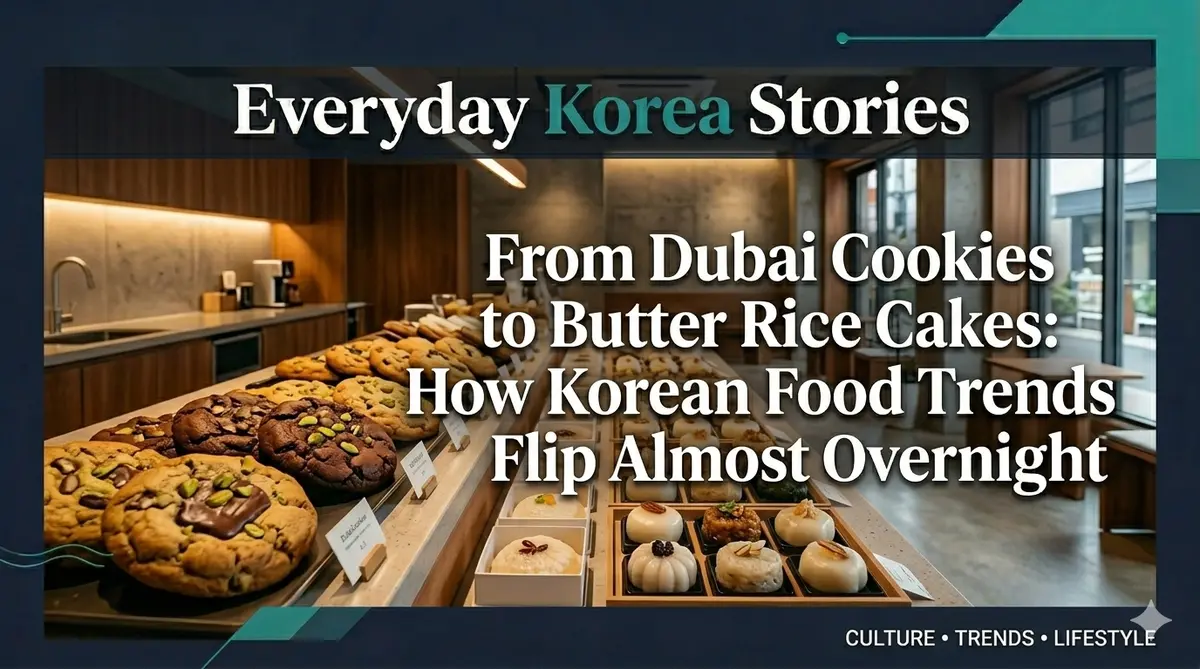
Until recently, one dessert dominated Korean café culture: the so-called “Dubai-style chewy cookie,” known locally as 두쫀쿠.
It was dense, oversized, and visually striking—often filled with pistachio cream or layered with crispy elements, marketed as a premium, imported-style treat.
Lines formed. Social media filled with close-up shots. Cafés rushed to add it to their menus.
Then something changed.
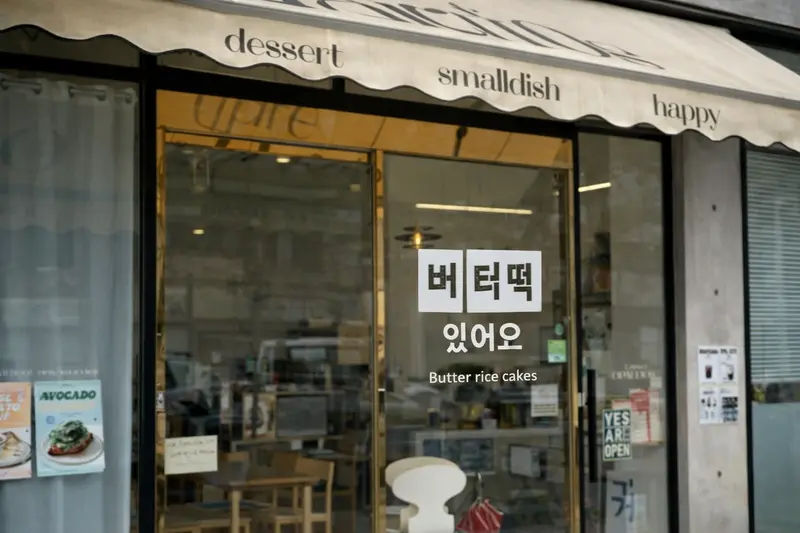
In many neighborhoods, those same cafés are now replacing 두쫀쿠 with a different item: butter rice cakes, or 버터떡.
In some cases, the transition is almost abrupt.
A sign that once advertised Dubai cookies now simply reads “butter rice cake.”
No explanation.
Just a quiet switch.
Why the Shift Is Happening So Fast
Part of the answer lies in timing.
Many café owners entered the 두쫀쿠 trend late. By the time they adopted it, the peak demand had already begun to fade.
The margins were not as strong as expected. Ingredients were relatively expensive. Competition increased quickly.
For those who missed the initial surge, the trend didn’t translate into significant profit.
Butter rice cakes offer a different equation.
They are simpler to produce.
They rely on familiar ingredients.
They can be easily adapted in-house.
Instead of competing on authenticity—trying to replicate an imported trend—cafés can reinterpret the product freely.
This gives small business owners more control.
And in Korea’s café ecosystem, that flexibility matters.
The Role of Online Culture
As with most trends in Korea, the shift is amplified online.
Short-form videos comparing 두쫀쿠 and 버터떡 are spreading quickly. Some emphasize texture differences. Others frame the transition as a kind of cultural pivot—from imported luxury to local reinterpretation.
There is also a noticeable tone in comment sections.
Fatigue.
Users mention how quickly expensive dessert trends rise and fall. Some express skepticism toward anything labeled as “foreign-style,” especially when prices are high.
At the same time, butter rice cakes feel more familiar.
They are rooted in tteok, a traditional Korean food, but presented in a modern café format—often with butter, sugar, or creative toppings.
That combination—familiar base, updated presentation—resonates strongly in Korean food culture.
A Pattern, Not an Exception
This kind of shift is not unusual in Korea.
A global trend arrives.
It spreads rapidly.
It peaks quickly.
Then it is replaced—often by a localized version.
The replacement is not always intentional.
It emerges from thousands of small decisions.
Café owners adjust menus.
Customers seek novelty.
Online platforms amplify what feels new.
And within weeks, the landscape changes.
Butter rice cakes are not simply replacing 두쫀쿠.
They are part of a broader pattern where imported trends are absorbed, reshaped, and sometimes displaced by something more adaptable.
What Café Owners Are Really Doing
For café owners, this is less about creativity and more about survival.
Margins are thin. Trends move fast. Being late can mean missing the opportunity entirely.
Many of the cafés now promoting butter rice cakes are run by owners who felt they entered the Dubai cookie trend too late to benefit.
This time, they are moving earlier.
Instead of waiting for a trend to peak, they are positioning themselves at the beginning of the next one.
In some shops, the shift is visible in real time.
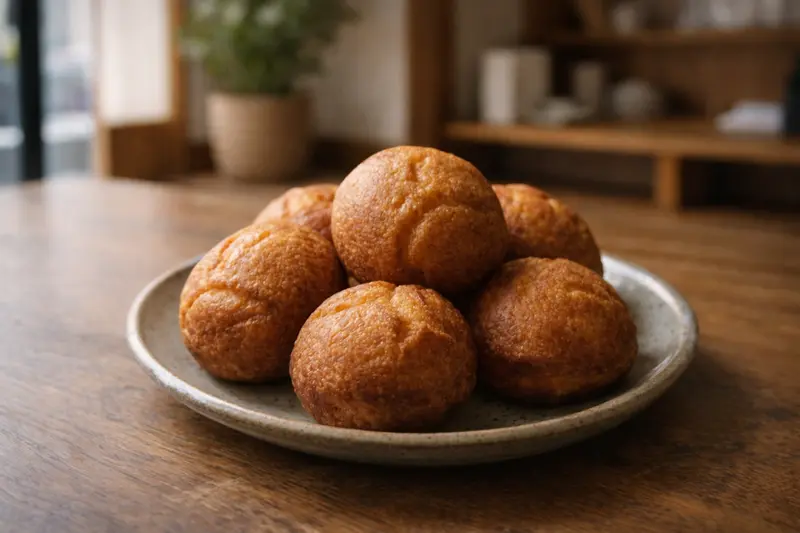
A display case that recently held oversized cookies now holds neatly arranged rice cakes with butter glaze.
A printed menu is crossed out and rewritten.
The change feels temporary—but intentional.
Why This Feels Different to American Readers
For American readers, food trends often move in cycles measured in months or years.
In Korea, the cycle can be much shorter.
Part of this comes from density.
Seoul has an extremely high concentration of cafés, all competing within close proximity.
Part of it comes from digital behavior.
Platforms amplify trends quickly, but they also accelerate fatigue. What feels new today can feel overexposed within weeks.
That creates a unique environment:
Speed becomes a competitive advantage.
And flexibility becomes essential.
Not Every Trend Becomes Permanent
It’s important to note that butter rice cakes are still at an early stage.
It is not yet clear whether they will become a long-term staple or simply another short-lived trend.
That uncertainty is part of the system.
Trends do not need to last to be successful.
They only need to move fast enough.
The Quiet Nature of the Change
What makes this moment interesting is how subtle it is.
There is no official announcement that one trend has ended and another has begun.
The change happens through small signals.
A menu swap.
A new display item.
A shift in social media posts.
Customers notice gradually.
And then, suddenly, the previous trend feels distant.
In Korea, even something as simple as a dessert can reveal how quickly a system adapts.
Not through large decisions.
But through many small ones, happening all at once.
Frequently Asked Questions
Q: What exactly is “Du-Jjon-Ku,” and why did it become such a sensation in Korea?
Answer: “Du-Jjon-Ku” is a portmanteau of the Korean phrase “Dubai-style Jjon-deuk (chewy) Cookie.” It refers to a viral dessert trend that combines a thick, soft cookie base with elements inspired by Middle Eastern sweets, such as pistachio cream and crispy kataifi pastry. Its popularity comes from the strong contrast in textures—chewy on the outside, intensely crunchy inside—which translates especially well on short-form video platforms, where both the visual break and the sound of the crunch became part of the appeal.
Q: Why are butter rice cakes becoming popular now?
Answer: They are easier to produce, more flexible to adapt, and feel more familiar to Korean consumers. After a wave of imported-style desserts, there is often a shift toward localized reinterpretations.
Q: As a visitor, how quickly do these trends change?
Answer: Very quickly. A trending dessert can dominate cafés for a few weeks and then be replaced by something new, so what you see depends heavily on timing.