The grill in the middle of the table is already hot.
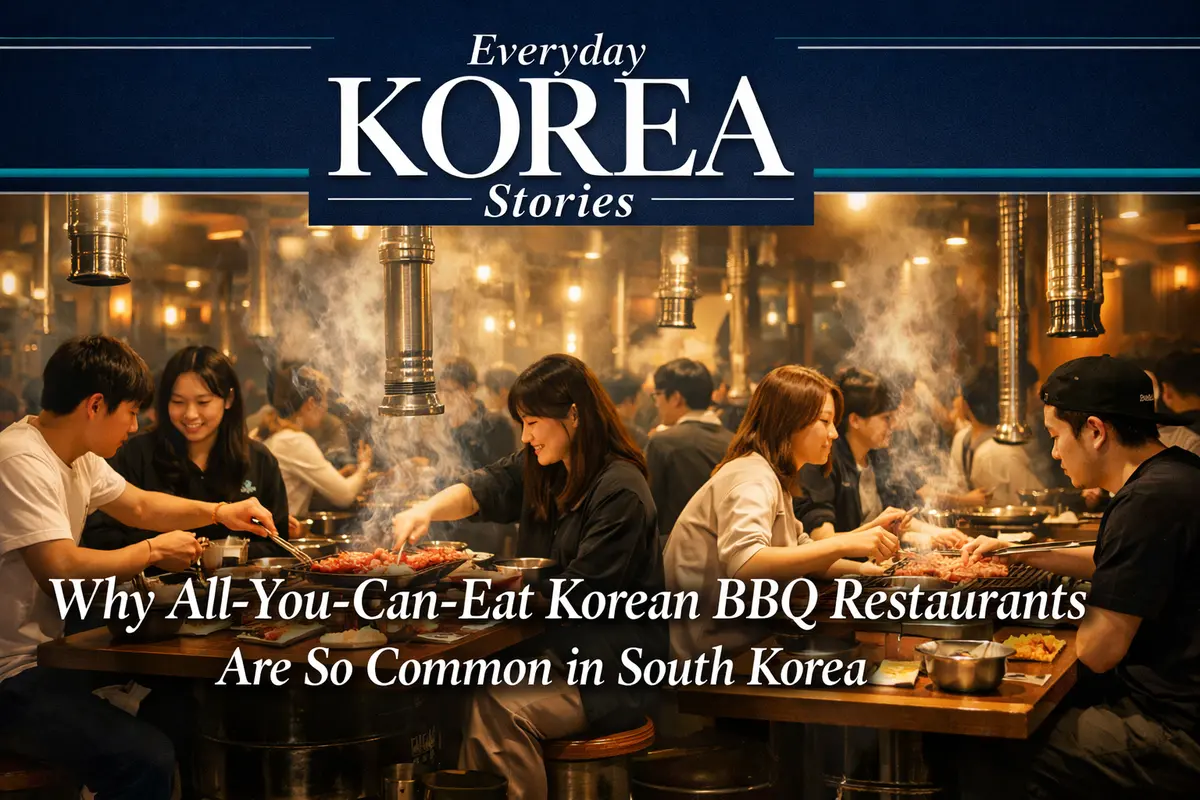
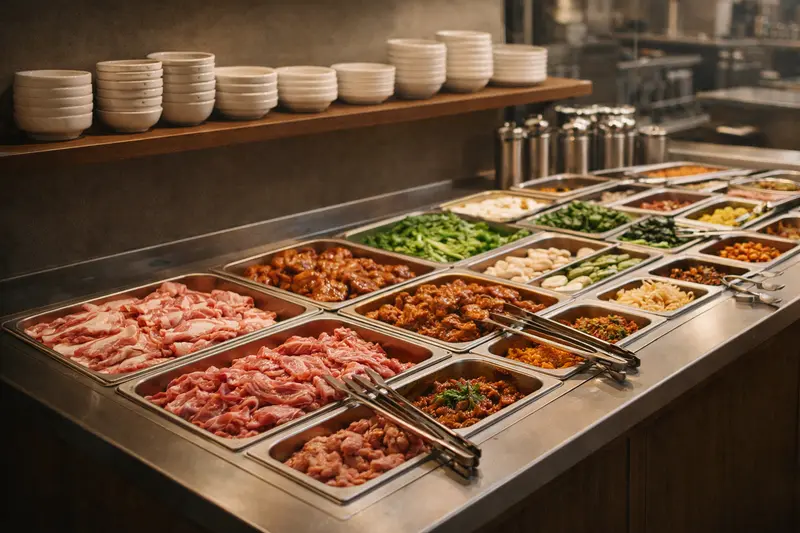
A group of university students sits down at a Korean barbecue restaurant near campus. One of them walks to a refrigerated counter along the wall and begins stacking plates with slices of pork belly and marinated meat. Another grabs lettuce, garlic, and side dishes from the buffet station.
Back at the table, the meat hits the grill.
Within minutes the first batch disappears. Someone stands up again and returns with another plate.
No one is counting how many servings they have taken.
They already paid the fixed price at the entrance.
Across South Korea, restaurants like this are common. Customers pay once and then continue bringing meat back to the table to grill themselves. This all-you-can-eat Korean BBQ model has become one of the most recognizable restaurant formats in the country.
For many visitors, the idea of unlimited meat can feel surprising. But the system fits naturally into the way Korean barbecue culture works.
Korean Barbecue Is Built Around Shared Grills
Unlike many Western restaurant meals, Korean barbecue is not served as a finished dish from the kitchen.
Instead, raw meat arrives at the table and diners cook it themselves on a grill built into the center of the table.
One person flips the meat.
Another cuts pieces with scissors.
Someone else wraps the grilled pork in lettuce and passes it around.
The meal becomes interactive and communal.
Because the cooking happens at the table, restaurants do not need large kitchens to prepare each serving. This structure makes it easier for restaurants to offer unlimited meat.
Instead of preparing dozens of individual orders, the restaurant simply keeps supplying raw meat.
Most Unlimited BBQ Restaurants Are Self-Service
Another important detail surprises many visitors.
At many traditional Korean barbecue restaurants, staff members help cook the meat. But all-you-can-eat barbecue restaurants usually work differently.
In most unlimited restaurants:
– customers bring meat themselves from a buffet station
– or staff deliver plates but do not cook the meat
– diners handle the entire grilling process at the table
This self-service approach reduces labor costs and allows restaurants to handle many customers at once.
In busy districts near universities, dozens of tables may be grilling meat simultaneously.
The restaurant supplies the ingredients. The customers cook the meal.
Why Students Love These Restaurants
Among Korean diners, students are some of the most enthusiastic customers of unlimited barbecue restaurants.
University groups often gather after exams, club activities, or sports practice. Because the price is fixed, everyone knows exactly how much the meal will cost.
For students with limited budgets, that predictability matters.
Large tables of teenagers and university students often fill these restaurants late into the evening, grilling meat while talking loudly with friends.
In many neighborhoods, unlimited barbecue restaurants become unofficial student gathering spots.
The Wrestlers’ Dinner Joke
Koreans sometimes joke about what would happen if an entire 씨름부 (wrestling team) walked into an unlimited barbecue restaurant.
Wrestlers are known for enormous appetites, and the image of a table repeatedly returning with mountains of meat has become a familiar joke.
In that situation, the restaurant owner might quietly worry about how much food is leaving the kitchen.
But in reality, most customers eat within predictable limits. The business model works because restaurants calculate average consumption across many tables.
Some groups eat a little less. Some eat a little more.
Over the course of a night, it balances out.
Alcohol Often Becomes the Real Profit
The unlimited meat itself is only part of the business strategy.
In many Korean barbecue restaurants, alcohol sales generate a large portion of the profit.
Group dinners in Korea frequently involve drinking, especially during company gatherings known as 회식.
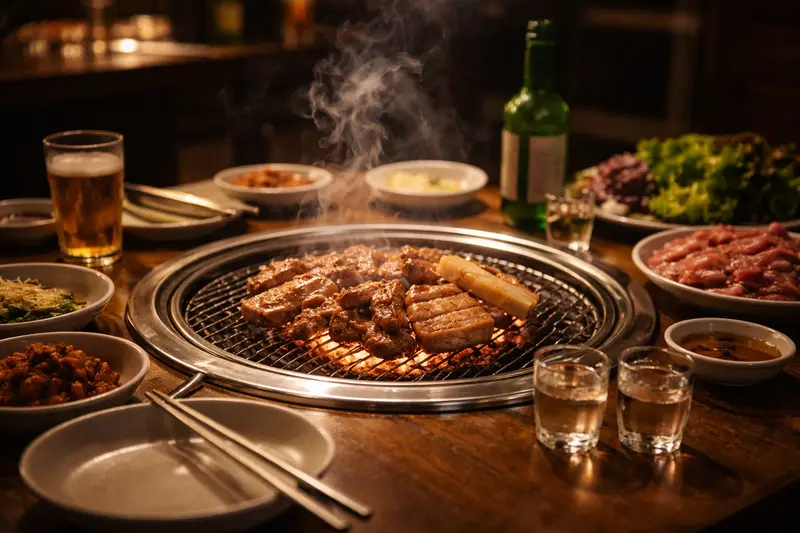
At these events, coworkers share multiple rounds of soju and beer while grilling meat at the table.
While the price of unlimited meat may remain relatively low to attract customers, alcoholic drinks often carry higher margins.
A table that orders several rounds of beer and soju can generate more revenue than the food alone.
For many restaurant owners, alcohol sales quietly sustain the business.
Designed for Group Dining
The unlimited model works especially well because Korean barbecue is already designed for groups.
Multiple people share the same grill. Plates circulate around the table. Someone is always reaching for another piece of meat.
Because the meal unfolds slowly as meat cooks batch by batch, diners tend to stay longer than they would at a typical restaurant.
Conversations stretch out while the grill continues sizzling.
In that environment, unlimited meat feels natural.
Instead of calculating each order, the table simply keeps the grill full.
Even Solo Diners Sometimes Try It
Korean barbecue restaurants are usually designed for groups, but occasionally someone arrives alone.
Eating alone in Korea is called 혼밥 (honbap).
Most restaurants now accommodate solo diners, but unlimited barbecue remains one of the more intimidating places to attempt it. The large grill and endless plates of meat are designed for shared tables.
When a single person confidently sits down and begins grilling meat alone, nearby diners sometimes glance over with curiosity.
Some people jokingly call it the final boss of solo dining.
Still, in modern Korean cities where single-person households are increasing, even that barrier is slowly disappearing.
A System Hidden Inside the Smoke
Seen from the outside, an unlimited Korean barbecue restaurant may look chaotic — smoke rising from grills, plates of meat moving across tables, glasses of soju clinking together.
But beneath the noise is a surprisingly efficient system.
Self-service meat, group grilling, and profitable drink sales combine to create one of the most recognizable dining formats in South Korea.
—
Frequently Asked Questions
Q: Do staff cook the meat in all-you-can-eat Korean BBQ restaurants?
Answer: Usually not. In most unlimited barbecue restaurants, customers grill the meat themselves. Many places even use self-service meat stations.
Q: How do these restaurants make money if customers eat unlimited meat?
Answer: Restaurants calculate average consumption and price meals accordingly. Alcohol sales—especially beer and soju—also generate significant profit.
Q: Is it normal to eat Korean barbecue alone?
Answer: It is possible, but still less common. Because barbecue is designed for shared dining, solo diners may stand out, though this is slowly changing.