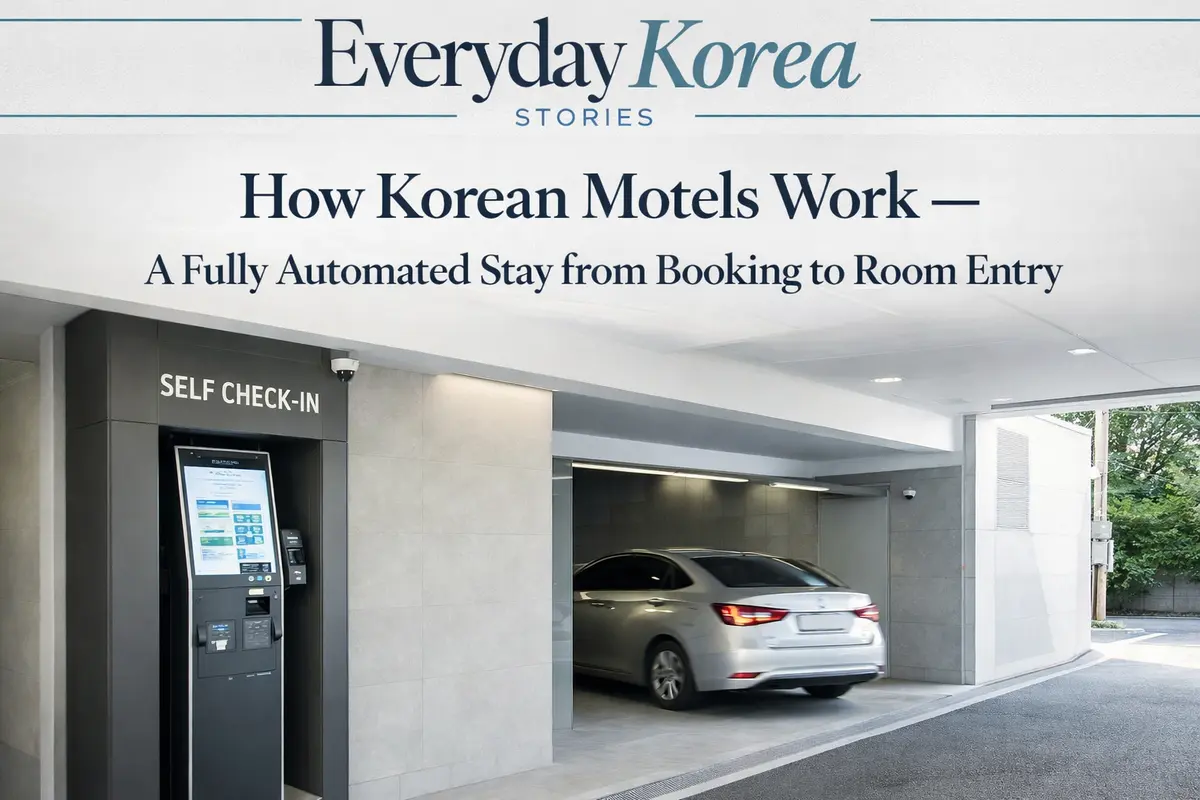
A car slows just enough to glance at a narrow entrance tucked between two buildings. Neon reflects faintly on wet pavement. There’s no doorman, no lobby glow spilling onto the street — only a quiet screen waiting under a canopy.
Inside the car, the decision has already been made.
A few minutes earlier, the driver had been scrolling through rooms on a phone. Prices shifting in real time, photos revealing interiors that all seem just slightly different. A tap. Payment confirmed. No reservation desk, no exchange of names.
By the time the car turns in, the system is already expecting them.
How Korean Motels Work Self Check In — A System That Begins Before Arrival
The experience rarely starts at the building itself. It begins in motion — on a subway, in the back seat of a taxi, or paused at a crosswalk with a phone in hand.
Platforms like Yanolja and Yeogi Eottae have quietly reshaped how space is accessed in Korea. Rooms are no longer something you arrive to negotiate for. They are selected, filtered, and secured before your feet ever touch the entrance.
The interface is almost deceptively simple. Nearby rooms appear, ranked by proximity and price, their availability updating in real time. A decision takes seconds. Payment follows immediately.
There is no anticipation of interaction. No expectation of waiting.
The room is not something you request. It is something you claim.
Elsewhere, accommodation still feels like an event — a process that begins at a front desk. In Korea, that process has already been completed by the time you arrive.
The Kiosk as Architecture, Not Equipment
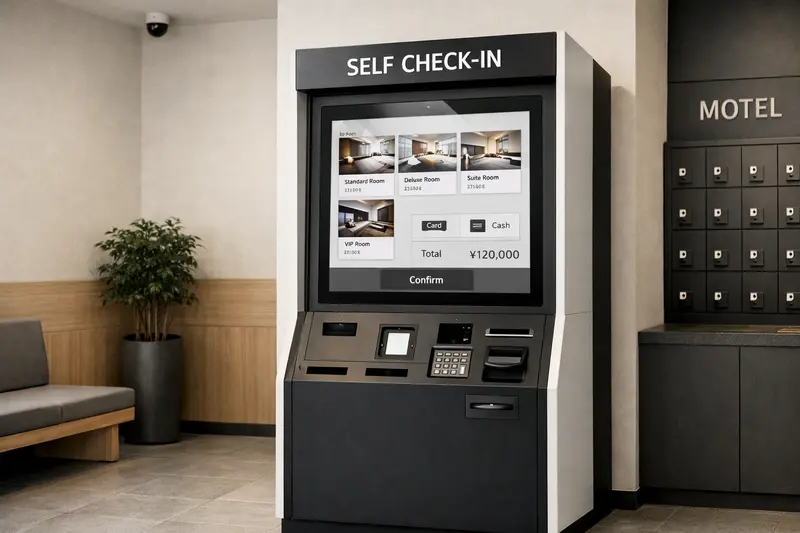
At the entrance, the kiosk does not announce itself as technology. It simply occupies the space where a person might have stood.
The screen offers choices, but without urgency. A few taps confirm what has already been decided — duration, room, payment. The transaction is immediate, but it doesn’t feel rushed. It feels settled.
Around it, the building remains quiet. No voices. No footsteps crossing a lobby. Just the soft mechanical response of a system recognizing completion.
A gate lifts. A number appears.
Nothing about the moment suggests service in the traditional sense. Yet nothing is missing.
Movement Without Encounter
Beyond the entrance, the architecture begins to reveal its intention.
The car moves forward into a covered space, where the city seems to fall away. Concrete walls narrow the field of view. Sound softens. The outside disappears almost completely.
Each parking space aligns with a room. A shutter lowers behind the vehicle, closing off the last visible connection to the street. From here, the path continues upward or inward, but always alone.
There are no intersecting routes. No shared corridors. No accidental encounters.
The absence feels deliberate.
In a city where movement is constant — subways packed at rush hour, sidewalks flowing with people — this kind of controlled passage becomes its own form of relief.
Inside the Room, the System Continues
The door opens without hesitation.
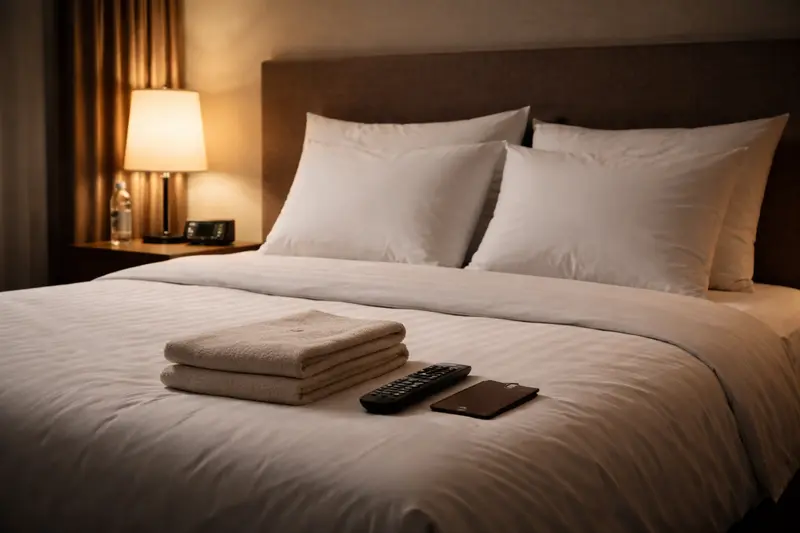
Inside, the room is already awake. Lights adjust softly. Air shifts to a comfortable temperature. Screens flicker on, not to demand attention, but to signal readiness.
Nothing needs to be explained. The space understands its purpose.
Controls are present but unobtrusive — panels, remotes, subtle indicators. The environment responds more than it requires input. It is less about operating a system, and more about entering one that has already been set in motion.
In many ways, the room feels less like a destination and more like a continuation of the process that began outside.
A City That Prefers Systems Over Interactions
What becomes clear, slowly, is that none of this exists in isolation.
The same patterns appear elsewhere — in convenience stores where payment happens without a cashier, in delivery systems that leave packages at the door without confirmation, in subway gates that open and close with barely a pause.
The motel is simply one of the most complete expressions of this logic.
Speed matters, but not as urgency. More as expectation. Systems are designed to remove interruption, not to impress.
Interaction is not eliminated entirely. It is reserved for when it is necessary.
Everything else is handled quietly, in advance.
Privacy, Not as Luxury, but as Default
For many visitors, the most striking element is not the automation itself, but what it allows.
There is no need to explain why you are there. No subtle negotiation of presence. No awareness of being observed.
The space accepts you without question.
In cities where density shapes daily life — where walls are thin, and public space is shared — privacy becomes something that must be constructed deliberately.
Here, it is built into the system.
The car, the kiosk, the room — each element participates in the same idea. Movement without exposure. Use without attention.
The Invisible Industry Behind It
What appears seamless on the surface is supported by a dense network beneath.
Hardware, software, access control, payment systems — all coordinated across thousands of locations. Companies specialize in refining each layer, from kiosks to room automation, from parking systems to digital booking platforms.
The same technologies appear in apartment complexes, gyms, and office buildings. Once learned, they require no explanation.
The system does not need to introduce itself.
It is already familiar.
When Efficiency Becomes Comfort
For someone encountering this for the first time, there is often a brief hesitation. A pause in front of the screen. A glance around, expecting someone to step in.
No one does.
And then the realization settles in: nothing is missing.
What initially feels impersonal begins to feel precise. The absence of interaction becomes a kind of clarity. No waiting. No uncertainty. No negotiation of roles.
Just a sequence of actions that unfold exactly as expected.
In a city that rarely slows down, that predictability carries its own kind of ease.
Not warmth in the traditional sense.
But something quieter. More controlled.
And, over time, surprisingly comfortable.
Frequently Asked Questions
Q: Can you really use a Korean motel without speaking to anyone?
Answer: Yes. In most unmanned motels, the entire process — from booking to entry — is handled through apps or kiosks. Human interaction is optional rather than required.
Q: Do you need to use apps like Yanolja before arriving?
Answer: Many people do, because it allows them to compare rooms and secure availability instantly. However, walk-in use through on-site kiosks is still common and works in a similar way.
Q: Is this system difficult for foreign visitors to understand?
Answer: It can feel unfamiliar at first, especially without visible staff. But most systems are designed to be intuitive, and many offer basic English support, making the experience easier after the first use.